
AccessComputing News December 2025
AccessComputing News is distributed about twice a year and features event highlights, updates on our projects, and profiles of people making a difference in the world of accessibility and inclusion. Subscribe online to receive the next issue in your inbox! Read this issue's articles below.
AccessComputing 2025: A Year of Change, Renewal, and Recommitment
By Maya Cakmak, AccessComputing PI
It’s been an eventful year at AccessComputing—much like it has been for computing itself, and the nation at large. It has been a particularly challenging period for the Broadening Participation in Computing (BPC) community, as several long-time partners have grappled with sudden and difficult grant terminations. Yet with every challenge comes an opportunity to reflect, adapt, and strengthen our commitments. Throughout it all, AccessComputing has continued to evolve while staying true to our long-standing mission.
NSF Alliance Renewal and a Redefined Scope
First, some good news: Our National Science Foundation (NSF CISE) Alliance funding has been renewed through 2026! Because of shifts at NSF, this renewal came with a revised scope, but it remains closely aligned with our original vision. As part of this transition, our Alliance has been renamed “Accessibility in the Computing Workforce” (AccessComputing Workforce) and is now focused on two core objectives:
- Expanding the Accessibility Workforce: Educate the next generation of computing innovators about accessibility, ensuring that all Americans can benefit from emerging technologies.
- Making Computing Accessible: Improve the accessibility of computing education, research, and career pathways so more Americans can enter the computing workforce well-prepared.
These goals reflect commitments shared by many of our partners, and we’re eager to continue collaborating to move them forward.
Navigating NSF Priority Changes
From the beginning, a foundational goal of AccessComputing has been to increase the representation of disabled people in computing education and careers. Through our work, we have learned that direct support for disabled students and faculty—across the entire career pipeline—is essential. Nearly two decades of NSF investment have significantly advanced this mission.
However, due to changes in priorities over the past year, NSF is no longer able to support activities that exclusively serve disabled individuals. As a result, some long-standing programs have shifted. For example, the NSF Research Experiences for Undergraduates (REU) supplements historically awarded to disabled undergraduate students regardless of research area, are now offered to students pursuing accessibility or computing-education research aligned with our project goals under AccessComputing Workforce.
Our AccessComputing Community Continues and Grows
These changes do not mean we are stepping away from our commitments to disabled students, faculty, and professionals. Quite the opposite:
- Our community remains at the heart of AccessComputing. We continue to gather, mentor, collaborate, and support one another, independent of any single funding stream.
- We are fortunate to have additional funding sources without the same restrictions, and we are redirecting them to sustain programs specifically focused on disabled students, such as AccessUR2PhD, which supports undergraduate researchers with disabilities.
- We are expanding our fundraising efforts to ensure the long-term sustainability of programs that remain essential to our mission.
New Opportunities Ahead
Despite the challenges, we are excited about what these changes enable. NSF’s willingness to let us focus more deeply on a subset of our goals, rather than reduce our funding, opens the door to more ambitious efforts, including bolder and larger scale accessibility curricula efforts, new initiatives to support teaching-focused faculty, and expanded research activities that advance accessibility in computing. We look forward to sharing more as these efforts take shape.
Just as importantly, these shifts have given us space to reflect on the tremendous impact of our community-focused programs—many of which NSF can no longer directly support—and to reaffirm our commitment to sustaining that work.
A Call to Our Community
We cannot do this alone. Disabled students and faculty need strong institutional and community-based support more than ever. We encourage you to continue uplifting disabled students at your own institutions through mentorship, research opportunities, inclusive teaching, and advocacy. As we grow efforts beyond our NSF Alliance, we also have new opportunities for partners to take on leadership roles within the broader AccessComputing community—roles that are not limited by the traditional structures of NSF-funded projects.
Thank you for being part of this community, for your resilience over the past year, and for your ongoing partnership as we chart the next chapter of AccessComputing together.

Capacity Building Award 2025: Kate Sonka of Teach Access
By Maya Cakmak, AccessComputing PI
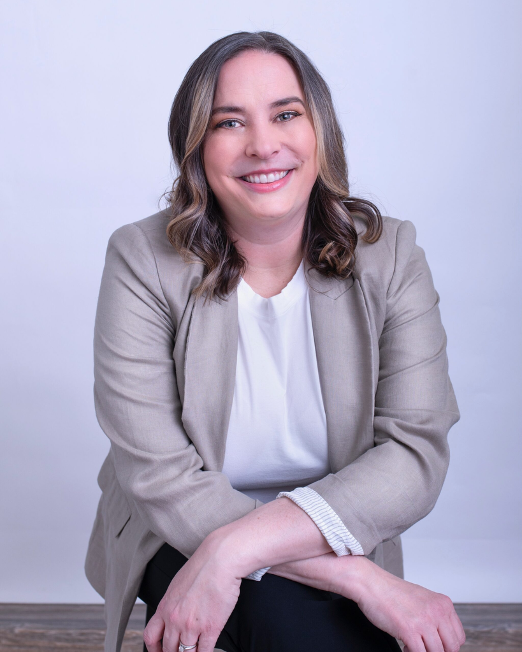
We are delighted to announce that the 2025 AccessComputing Capacity Building Award goes to Kate Sonka, executive director of Teach Access. This award honors AccessComputing partners who forge pathways that meaningfully advance accessibility in computing. Through her leadership, Kate has expanded how educators, technologists, and institutions integrate accessibility into computing education and practice.
Kate has led Teach Access since 2019 and brings experience across higher education, industry, and nonprofit organizations. Under her leadership, Teach Access has grown from a largely volunteer-run initiative into a fully staffed 501(c)(3) that equips thousands of faculty and students with the knowledge and tools to build accessible technology. She has championed faculty development, immersive learning experiences, and strategies for embedding accessibility into curricula at scale.
Teach Access itself has seen remarkable growth in recent years. Since 2021, the organization has formalized a governing board, secured more than $3 million in funding, expanded its programs and resource offerings, and reached over 700,000 students and 2,000 faculty across more than 200 U.S. institutions. Its mission—to prepare a future workforce that designs technology born accessible—continues to gain national momentum and is closely aligned with our NSF AccessComputing Workforce Alliance. With a new three-year strategic planning effort underway, Teach Access is poised for its next phase of impact and we are thrilled to continue our partnership with them under Kate’s leadership.
Kate’s work exemplifies what the Capacity Building Award seeks to recognize: Vision, collaboration, and sustained contributions that strengthen the pipeline of accessibility-aware technologists. Please join us in congratulating Kate Sonka and Teach Access on this well-deserved recognition, and in celebrating the continued growth of accessibility leadership across our community.
AccessADVICE
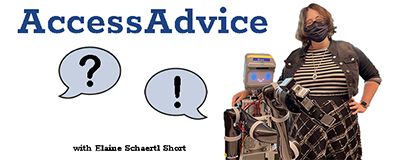
By Elaine Schaertl Short, AccessComputing Co-PI
[This question has been lightly edited for clarity]
How can I handle it when I get overwhelmed by just the idea of working on my computer? I'm beginning to realize I subconsciously avoid doing tasks on my computer unless I absolutely have to. I definitely have a "millions-of-tabs" problem, and I also get distracted every time I open my laptop because I've left up the unfinished page/task from last time. I know those are habits I can work on, but do you ever deal with something similar? Any advice for solutions, resources, or systems I could create/set-up on my computer that could reduce the mental stress of computer tasks?
—
First, I want to give you some specific advice for dealing with computer-based tasks. If you can use physically different computers (or devices) for “fun” and “work”, it can help with distraction (don’t put anything fun on the work computer) and get you in the “work time” mindset. Most people won’t be able to have two personal computers for this, but there’s probably a way to get access to a “work computer” somehow – in a campus lab for undergrads, or through your department or advisor for grad students. Even if it’s less convenient, the act of physically moving to a different location can also help get your brain into “work mode”, and shared computers will often force you to close out of everything at the end of a work session, helping with the unfinished task overflow. If you can’t use a physically different computer, you could also set up a separate user just for work tasks to get some of the benefits.
If you find that you’re getting stuck because you have a half-done task that you don’t know how or don’t want to continue with, try Hemingway’s advice and stop in the middle of the “easy part” of a task. Sometimes that can be enough to help you build momentum to carry you through the difficulty of starting up again. Alternatively, you can make sure you close everything down so you’re starting from a clean slate every time.
You might also be able to work away from the computer for some things: Print out papers you need to read; look into an e-ink tablet you can hand-write on (most such tablets will also convert your handwriting into editable text); do brainstorming and first drafts in a physical notebook; use speech-to-text on your phone to speak your first draft out loud; try calling instead of emailing (phone calls can be unfriendly to the neurodivergent crowd, but everyone’s different--could be worth a try). You might also find that this page (especially the “Assistive Technologies” section) has some advice or techniques that you’d find helpful.
More broadly, one of the most useful things you can figure out in your career is your own personal toolkit for how to get things done especially when you really, really don’t want to, whether because you’re overwhelmed, exhausted, sad, stressed, angry, or confused. I’ll give you a few examples of things that I do that help me, but they’re pretty unlikely to directly help you; everyone’s brain is different. I do an exercise in my assistive technology class where students share their personal organization tools, and I’m always impressed with the sheer variety of different tools and strategies students use.
For a couple examples from my own life, I find that telling someone what I want to get done, even if I’m just telling them that I don’t want to do it, seems to help with getting started. I have some friends I’ll do writing sessions with sometimes, where we all say what we’re planning to do, then work for 45-60 minutes before reporting back. I’ve also learned over my career that bribery doesn’t work on me – some people like to give themselves a little treat as a reward for getting difficult tasks done, but that’s never motivated me. Instead, I like to have a “done” list, where tasks go once they’re checked off the “to-do” list. I get a kick out of seeing a list get longer or a number go up. I’ve even made myself trackers for counting the number of emails I’ve answered or the number of words I’ve written when I’m especially struggling with those tasks.
Like I said, however, these strategies are pretty unlikely to work for you directly, so it’s really a matter of finding your personalized techniques. Most importantly, I want to point out that nothing you try has to be permanent, and realistically probably won’t be. Try something, see if it helps, then discard it if it doesn’t. Or if something that was working stops working, try something else. Set aside some regular time to review if what you’re doing is working for you or not, and give yourself the chance to adjust if needed. “Regular” can also vary: if you’re actively struggling, you might try different things on a week-by-week basis, or if things are going well, checking in every semester might be often enough. Over years of trying different things, I’m sure you’ll pull together a pretty good toolkit of strategies for different situations and different challenges (and of course, asking for advice like you did here can always help as well!), whether it’s problems with computers or any of the other little challenges we all face along the way. Good luck!
Recent Awards to AccessComputing Community Members
By Brianna Blaser, AccessComputing Director and Co-PI
Several AccessComputing community members have received awards and publicity in recent months. Please join me in congratulating these members of our community.
- AccessComputing Team member Cynthia (Cindy) Bennett received the Computing Research Association Skip Ellis Early Career Award. The Skip Ellis Award “recognizes early career individuals in academia, industry, or government research labs who exemplify the spirit of Skip Ellis through significant research contributions and outreach that broadens participation in computing.” Cindy, a graduate of UW’s Human Centered Design and Engineering PhD program and now a staff research scientist at Google, describes her research as "involving disabled people as the experts of their own lived experiences and accessible futures for everyone." Beyond her research, Cindy is a leader in accessibility and an incredible mentor.
- AccessComputing Team member Maria Fanelle, a graduate student at Tufts University and a networking and security engineer at The MITRE Corporation, was named Lime Connect’s 2025 Leadership in Disability Awardee for her leadership in framing neurodiversity as an asset.
- AccessComputing co-PI Stacy Branham (University of California Irvine), received the Alumni Impact Award Virginia Tech Center for Human Computer Interaction. Stacy, a graduate of Virginia Tech, was honored to be celebrated by her alma mater.
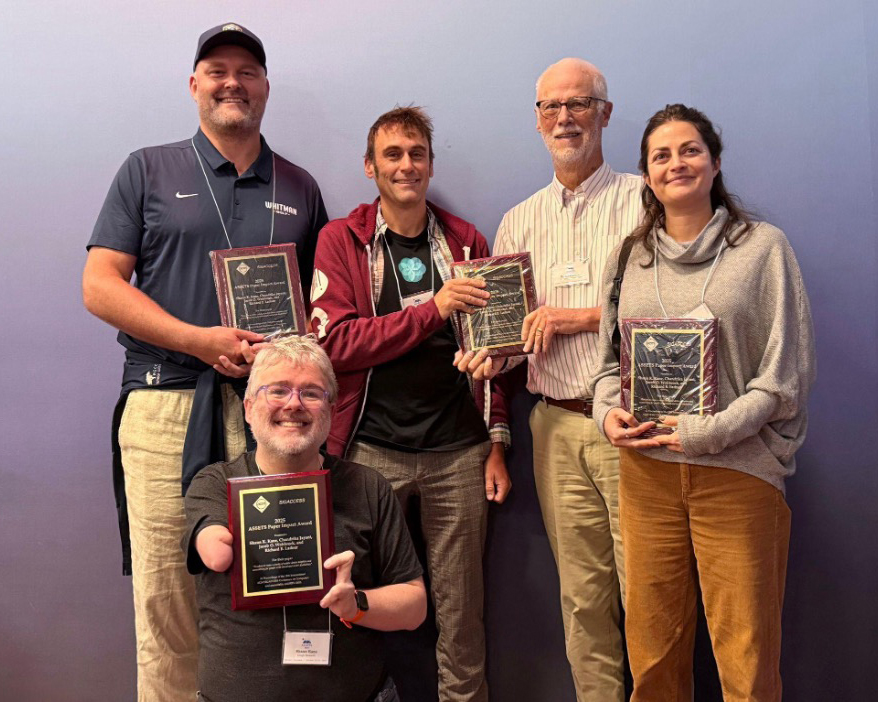
- The 2009 ASSETS paper “Freedom to roam: A study of mobile device adoption and accessibility for people with visual and motor disabilities”—authored by friends of AccessComputing Shaun Kane (Google), Chandrika Jayant (Be My Eyes), former co-PI Jacob Wobbrock (University of Washington), AccessComputing founding PI Richard Ladner (University of Washington)—received the 2025 ASSETS Paper Impact Award. See separate article for more information.
- AccessComputing partner Megan Hofmann (Northwestern), who has mentored AccessComputing research experience for undergraduate participants, was highlighted in the Computing Research Association’s News article Cultivating Future Computing Researchers: The Critical Role of Mentorship in CRA-WP’s NSF DREU Program.
- AccessComputing partner Wendy Ingram, founder of Dragonfly Mental Health, was profiled by UC Berkeley’s Alumni Association in the article “Action is my coping mechanism”: Wendy Marie Ingram on building community care in academia.
- AccessComputing partner Alannah Oleson (University of Denver) received an Excellence in Undergraduate Mentoring Award from the University of Denver. In addition, with their undergraduate student Muskan Fatima, they received funding from the University of Denver to work on two accessibility-related projects and together with colleagues from the University of Glasgow (Scotland) and Uppsala University (Sweden), they secured seed funding to kickstart a longitudinal, multi-institutional collaboration investigating the “not my job” fallacy among computer students—which occurs when they believe that “someone else” will handle accessibility, ethics, and inclusion issues in their software so they don’t have t—and produce actionable strategies to support students’ ethical agency development.
- Friend of AccessComputing, Hala Annabi (University of Washington) received a $15 million grant from the Canopy Neurodiversity Foundation to establish the UW Institute for Neurodiversity and Employment, which seeks to build capacity to create meaningful employment opportunities and career experiences for neurodivergent people.
The 2025 SIGACCESS ASSETS Paper Impact Award
By Richard Ladner, AccessComputing Founder
Every two years, ACM SIGACCESS gives the SIGACCESS ASSETS Paper Impact Award to a paper published in the ASSETS Conference from 10 or more years prior “that has had a significant impact on computing and information technology that addresses the needs of persons with disabilities.” This year, at the ASSETS Conference, the SIGACCESS ASSETS Paper Impact Award went to 2009 ASSETS paper “Freedom to roam: a study of mobile device adoption and accessibility for people with visual and motor disabilities,” by Shaun K. Kane, Chandrika Jayant, Jacob O. Wobbrock, and Richard E. Ladner. Wobbrock and Ladner are former Co-PI and PI of AccessComputing, and Shaun Kane, now at Google, was their former co-advised PhD student. Chandricka, now at Be My Eyes, is a former PhD student of Ladner.
What made this paper so important over the past 16+ years is two-fold. First, powerful mobile devices such as smartphones, smartwatches, and others have become standards in society worldwide. Second, the accessibility of these devices has improved over that time as a result of many innovations and studies, many of which can be traced back to this paper. The paper, through its foundational interviews and diary studies, delineated the most important issues around the adoption and use of these devices for blind, low vision, and mobility disabled users. Among these issues are the desired functions of their devices, usage in the world outside of home and office, usage while walking, and coping with device failure. The mobile devices available at the time of the study were not as accessible as they are today, so users had to find ways to get around their inaccessibility, often by getting help from other people.
Among the mobile devices used by participants in the study were not just feature phones, smartphones, and music players, but GPS devices, magnifiers, braille notetakers, and game consoles. Except for braille notetakers, all the functions provided by these extra devices are in today’s smartphones. Now, the Braille notetaker can be replaced by a Bluetooth-compatible and much cheaper Braille input/output device. Participants in the study already seemed to sense that many of the functions they desire–screen reader, speech input, OCR, and music player–could be put into one mobile device, rather than in separate devices. Two of the 19 participants in the study even mentioned user-installable applications, anticipating the iPhone App Store.
AccessComputing’s Impact on the 2025 ASSETS Conference
By Richard E. Ladner, AccessComputing Founder

The conference was opened with a plenary keynote by Jenny Lay-Flurrie, vice president and chief accessibility officer at Microsoft. Her talk was visionary, speaking to the current and future impact of artificial intelligence (AI) on accessibility. She also talked about the collaboration that Microsoft has with accessibility related organizations and companies. In particular, she discussed a new partnership between Microsoft and Be My Eyes, a smartphone app that can be used to connect blind or low vision users who want assistance from human or AI assistants.
AccessComputing partner representatives, who are also accessibility researchers, were authors or co-authors on 28 papers and 12 posters or demos at the conference. The best paper award went to a paper co-authored by Megan Hofmann who represents Northeastern University as an AccessComputing partner. It is a fascinating paper titled “‘As Someone Who is Disabled, I am so thankful for Sex Work’: Alternative Approaches to Access Among Disabled Sex-Workers.” Based on interviews with 12 disabled sex workers (escorting, webcamming, lap dancing, etc.), the authors of the paper develop a framework, systems of access, to analyze how disabled sex workers develop access strategies that include safety and other factors.
ASSETS 2025’s organizing committee also had many AccessComputing partner representatives. The General Chairs were Kristen Shinohara, partner who represents Rochester Institute of Technology and Shaun Kane, former partner who represented the University of Colorado at Boulder and is now at Google. One of the Treasurer/Registration Chairs was Elaine Short, Co-PI of AccessComputing. One the Posters and Demos Chairs was Catherine Baker representing Creighton University. One of the Doctoral Consortium Chairs was Maitraye Das who represents Northeastern University. The Mentoring Chair was Yasmine Elglaly who represents Western Washington University. One of the Experience Report Chairs was Amy Hurst who represents New York University. At least 18 members of the Program Committee are AccessComputing partners. All this leadership by AccessComputing partners demonstrates the common cause of the ASSETS community and AccessComputing to make computing more accessible.
AccessComputing Workforce Minigrants Available
By Lyla Crawford, AccessComputing Staff
Join AccessComputing Workforce in educating future computing innovators about accessibility and ensuring that computing education is accessible to all. By applying for an AccessComputing Workforce minigrant, you can help advance training, experiential learning, and other computing related activities nationwide.
We anticipate most awards to be in the $4,000–$5,000 range. Proposals may be submitted at any time, but funding is limited. Individuals, institutions, or organizations are welcome to apply for funding that will be used for these types of activities:
- A workshop for faculty focused on adding accessibility content to computing courses
- An outreach event for computing students to expose them to accessibility-related topics
- Presentations to a school or a department by an accessibility expert to encourage faculty to adopt accessible practices or teach about accessibility
- Accessibility hackathons that bring together students, mentors, and community members to teach, learn, and develop accessible technology
- The development of resources that encourage the integration of accessibility into computer science education, including blogs, podcasts, curriculum, or webinars
- Revise curriculum according to universal design principles or other high-leverage practices and share their experiences with other faculty
- Revise a course to add a unit or lesson related to accessibility and share related resources with other faculty
Below are featured funded minigrant-funded projects:
- Researchers at the University of Maryland Baltimore County (UMBC) organized a two-day workshop, titled Best Practices for Accessible Makerspace Design, held at the Arecibo Observatory, Puerto Rico. The workshop brought together researchers, practitioners, and community partners to discuss key considerations in developing accessible makerspaces, focusing on accessibility, cultural relevance, and engaging the local community. The event was funded by AccessComputing and the National Science Foundation Division of Research and Learning in Formal and Informal Settings (#2321761).
- A team at the University of Illinois is developing a first-person shooter video game to teach about accessible design through immersive experiences where players navigate limited visual or auditory modes and use accessibility features. User studies and co-design sessions will gather feedback from both non-disabled participants and people with disabilities, especially those who are blind, low-vision, D/deaf, or hard-of-hearing. The project involves 90-minute user sessions and 120-minute co-design sessions, with compensation for participants, aiming for up to 200 and 20 participants, respectively.
- A faculty member at the University of North Texas received support to host the Universal Design (UD) and Best Practices in CS Education to Support Success for Students with Disabilities event designed to “increase efficacy for faculty in UD and enable them to translate UD principles and accessibility best practices into actionable practices in their CS courses to increase access to Computer Science for all students.
To apply, complete the AccessComputing Workforce Minigrant Application Form. For questions, contact Lyla Crawford at lylac@uw.edu.
Recent AccessComputing PhD Graduates
By Kayla Brown, AccessComputing Staff
Several AccessComputing Team Members completed their PhDs in 2025. Congratulations to each of them on this important milestone in their careers!
Rahaf Alharbi – Ph.D., School of Information, University of Michigan
Dissertation: Reimagining Privacy and Transparency in Visual Assistance Technologies With Blind People
Rahaf is now an assistant professor at the Pratt Institute School of Information, where she teaches and conducts research on accessibility, disability studies, the ethical implications of technology, privacy, and human–computer interaction.
Bahar Shahrokhian – Ph.D. in Computer Engineering, Arizona State University
Dissertation: Toward Smarter In-Person Classrooms Through Speech Analytics
Bahar' research focuses on multimodal learning analytics to improve real classroom experiences through methods that process speech in noisy environments, detect teacher activities, and analyze student collaboration via vocal interactions.
Chorong Park – Ph.D. in Technology, Purdue University
Dissertation: Trust, Affection, and Autonomy: Designing Joyful and Inclusive VR/AR, AI, and Robotic Companions for Older Adults
Chorong's doctoral work centers on making technology more accessible and empowering for older adults and people with disabilities. She is now an assistant professor at the University of Houston.
Yasha Iravantchi – Ph.D. in Computer Science, University of Michigan
Dissertation: Usable and Ubiquitous Privacy-Aware Sensing Devices
Yasha' ddressinYashaddressing major challenges in the adoption of smart sensing in homes and healthcare, with a focus on user privacy
Yasha is the recipient of the Kuck Dissertation Prize for exceptionally impactful CSE dissertations and is now a postdoctoral fellow at Stanford University.
Nahideh Salehifar – Ph.D. in Electrical and Electronics Engineering, Missouri University of Science and Technology
Dissertation: Metal Organic Thin Film Coated on Optical Fiber Gas Sensor
Nahideh's research includes developing UV-based gas sensors, fiber-optic sensors, and electronic noses for industrial and harsh environmental applications, integrating nanotechnology with innovative sensing approaches.
Cassidy Pyle – Ph.D. in Information Science, University of Michigan School of Information
Dissertation: Investigating Affirmative Action Discussions on Social Media
Cassidy' dissertation research examines how people discuss affirmative action in U.S. college admissions across social media platforms. She is now a postdoctoral fellow at the University of Michigan working on projects related to AI-mediated communication.
New Webinar Recordings
By Brianna Blaser
There are multiple new recordings available from DO-IT projects that offer opportunities to learn about accessibility and disability inclusion. Check them out:
- GitHub's pledge to help improve the accessibility of open source software at scale with Ed Summers and Maria Lamardo of GitHub
Given that technology is a ubiquitous and essential part of modern life, and approximately 16% of the human population have a disability, it is critical that people with disabilities are able to contribute to the development of the technology that is used by all. The challenge is that proprietary Assistive Technology products can be very expensive, and people with disabilities are unemployed or under-employed at higher levels than the general population so open-source assistive technology is imperative. This webinar will share information on how GitHub is working to make that happen. - Seven practical moves toward disability justice in computing education - with Amy J. Ko, University of Washington
Amy will discuss how—employing a disability justice lens and embracing its intersections with other systems of oppression around race, gender, and class—she strives to apply a Universal Design in Learning (UDL) framework to her teaching. She'll share her philosophy on UDL and share 7 heuristics she has developed for accessible teaching in computing. - Generative AI and Accessibility Benefits, Trade-offs and Impacts of Intersectionality with Kate Glazko, University of Washington; Jun Cha, University of Wisconsin; and Sev Huffman, Gallaudet University & University of Washington, funded by AiiCE
Researchers present findings on the the benefits, trades offs and impacts of using Generative AI for accessibility by members of the Deaf/HoH communities and Neurodivergent individuals. In the first, Glazko & Cha, et. al., discuss how neurodivergent people, often left out by existing accessibility technologies, develop their own ways of navigating normative expectations. GAI offers new opportunities for access, but it is important to understand how neurodivergent “power users”—successful early adopters—engage with it and the challenges they face. In the second one, Huffman, et. al., discuss Generative AI tools, particularly those utilizing large language models (LLMs), and how they are increasingly used in everyday contexts. While these tools enhance productivity and accessibility, little is known about how Deaf and Hard of Hearing (DHH) individuals engage with them or the challenges they face when using them.
My Experiences at RESPECT
By Cole Balay, AccessComputing Team Member
I was able to attend at least one session for each of the four session periods. Per my interest in CSEd, I attended many education sessions. At these presentations, I appreciated the valuable opportunities to connect the current knowledge I have about CSEd (and broadening participation) to new information.
In addition to new information, I discovered and created new connections with faculty and students. I noted many faculty who work in my discipline of interest, and who I might contact when applying to grad school. But particularly important to me was networking with current and recent PhD students, who could share perspective and current insight on their program experience. I connected with students at NJIT, UW, UMBC, University of Florida, and Emory. At the poster session dinner, we all sat together, and I enjoyed a table-full of PhD students eager to answer my wide array of questions. A notable experience I had was with Shaniah Reece from Emory, who walked me by all the posters and explained to me how a Doctoral Consortium works.
Finally, I appreciated the theme of Accessibility in CS highlighting presentations and discussions on widening participation for the disabled community in CS. The entirety of session 11A on the second day felt as if it was made specifically for me, as a disabled student seeking grad school and conferences. My story does not often feel so valid and relevant to large populations. It is not only of personal interest for me to learn about disabled students in CS, but as I advertise myself to be interested in education accessibility for all, I commit to truly including all by learning about accommodations and widening my perspective for my consideration of future work, curriculums, programs, and research.
In conclusion, I have found such value in this conference, and hold so much appreciation for your funding of my RESPECT experience. After attending SIGCSE in February, I was certain that this conference would be another impactful opportunity I could not pass up; however, I was concerned about funding. The support you have offered removed a serious barrier to my education and academic career. I thank you not only for supporting me, but for all students you support in getting to conferences. We all thank you. For us, this makes all the difference.
AccessUR2PhD Representation at the 2025 CMD-IT/ACM Richard Tapia Celebration of Diversity in Computing Conference
By Kayla Brown, AccessComputing Staff
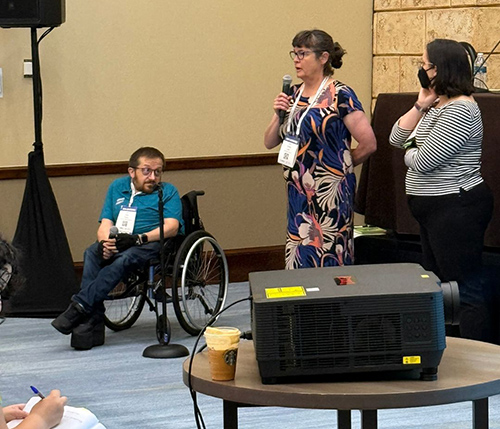
AccessUR2PhD was delighted to participate in the 2025 CMD-IT/ACM Richard Tapia Celebration of Diversity in Computing Conference in Dallas, Texas this September. At the conference, we hosted a workshop on Accessibility in Computer Science featuring faculty, researchers, and PhD mentors sharing their work and experiences, and organized networking opportunities for participants to build connections in the accessibility community. We also helped fund a group of students to attend; some presented research, others engaged in networking, and all attended sessions designed to support their computing trajectories.
In addition, we hosted a Birds of a Feather session titled Diversity Includes Disability, led by Brianna Blaser (University of Washington), Rob Parke (USC), and Cathy Law (Oregon State University). The session convened people with disabilities and allies to share experiences, strategies, and resources for achieving success in computing fields. Through introductions, discussion of internships, mentoring, career development, and best practices for educators and employers, the session fostered community, resilience, and actionable ideas at a moment when inclusive practices are under pressure.
My Experience at Tapia 2025: Finding My Community in Accessibility Research
By Hans Djalali, PhD Candidate, University of North Texas

As a PhD candidate whose research focuses on accessibility and human-computer interaction, I was thrilled to attend the 2025 CMD-IT/ACM Richard Tapia Celebration of Diversity in Computing in Dallas, Texas. With support from AccessComputing, I had the opportunity not only to learn from leading researchers but to find a community of people who share my passion for making computing accessible to everyone.
The highlight of my Tapia experience was serving as a guest panelist at Saturday's workshop on Accessibility in Computer Science, organized by AccessUR2PhD. This full-day session brought together faculty, researchers, and PhD mentors to share their work and experiences with students considering graduate school. I discussed PhD pathways for students interested in accessibility research. Speaking to students who reminded me of my younger self, eager to make technology more inclusive but unsure how to start, was deeply meaningful. Throughout the conference, I attended sessions that directly connected to my work. The "Diversity Includes Disability" Birds of a Feather session, led by Brianna Blaser (University of Washington), Rob Parke (USC), and Cathy Law (Oregon State University), created space for people with disabilities and allies to share strategies for success in computing. As an ODA student myself, these conversations reminded me why I chose to study accessibility: the barriers I faced navigating inaccessible technology are the same barriers I now work to eliminate through my research.
Friday's "Bridging the Accessibility Gap" session on inclusive career pathways reinforced my commitment to mentoring the next generation of students with disabilities in computing. My experience teaching K-12 robotics and mentoring undergraduate researchers has shown me the impact of accessible education. Beyond the formal sessions, Tapia provided countless opportunities to network with researchers, industry professionals, and fellow students. I left the conference with new collaborations in mind and a clearer vision for my research agenda.
I am grateful to AccessComputing for supporting my attendance. This experience strengthened my commitment to accessibility research and to building a computing field where diversity truly includes disability.
My Experience at Tapia 2025: Networking
By Nathan Perez
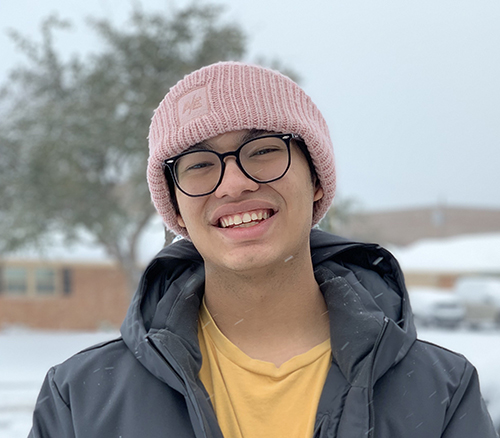
My name is Nathan Perez, I am a final year undergraduate student at the University of Texas at Dallas (UTD). After graduation, I'll be joining Fidelity Investments as a software engineer from an opportunity that arose at the 2025 Tapia conference. I've been a member of AccessComputing since 2023, and both AccessComputing and Tapia have played meaningful roles in my personal and professional life.
I first heard about the Tapia conference in 2023 through UTD’s ACM club, when I received an email asking for volunteers for the upcoming tapia conference. Not knowing what to expect I signed up to volunteer.
At my first Tapia conference, I was introduced to various organizations and programs I was previously unaware of such as STARS computing core, CMD-IT, Computing Research Association, and of course AccessComputing. Since then, being involved with AccessComputing has both opened doors to opportunities, and given me a sense of belonging in the computing community.
Professionally, Tapia was invaluable. Being able to talk with people who could help answer my questions about what career paths would fit my interests, tips to improve my resume, and the skills required for my goals, proved extremely helpful. Additionally learning about what researchers were working on helped me hone my interests, giving me insight into REU programs and how explainable AI and Human Computer Interaction would be a good fit for me in the future. Without the advice and help of others at Tapia I know it would have been more difficult to find jobs and explore interests, and I'm grateful for the people that took time out of their day to help me.
With the conference back in Dallas in 2025, and with the support of AccessComputing, I was able to attend again this year. I enjoyed the talks this year, especially those exploring AI's role in education, the biases present in AI systems, and HCI talks focused on accessibility. This year the career fair ended up being the most impactful part of the conference for me, as on the third day of the conference I had an interview that would become my full-time job offer.
I'm incredibly grateful for both AccessComputing and the Tapia Conference. Both have shown me that I belong in computing, and that I am part of a community of people who would help to support me professionally.
RESPECT 2025: Designing an Accessible Future for Equitable Computer Science
By Brianna Blaser, AccessComputing Director and Co-PI
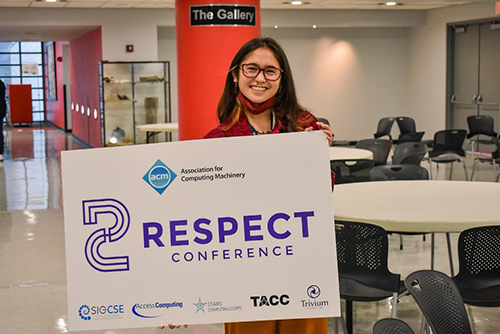
The ACM SIGCSE Conference on Research on Equity and Sustained Participation in Engineering, Computing, and Technology (RESPECT) 2025, held in July in Newark, NJ, was the first RESPECT conference to have a theme related to accessibility. Authors were asked to make a good faith effort, even if accessibility was not the primary topic of their research, to attend to accessibility at least in terms of future research directions or limitations. In addition, the Accessibility Chair, Alexis Cobo, led efforts to ensure that the proceedings were accessible, a first for a SIGCSE conference.
We were excited to see many AccessComputing partners and friends at the conference; many wrote papers, featured below:
- Implications of Disability Definition, Determination, and Data Collection - Richard E. Ladner, Maya Cakmak, and Brianna Blaser
Empowering Disabled Engineers through Accessible Co-Curricular Activities - Mavis Murdock, Katherine H. Allen, and Elaine Short
Inspiring Blind and Low Vision High School Students and their Teachers to Access STEM in College - Isabela Figueira, Josahandi M. Cisneros, Julieta Lindo, Vinh H. Luong, and Stacy M. Branham
Fostering Equity and Access to Empower Marginalized Communities through Making - Maria Lopez-Delgado, Kevin Lemus, and Patricia Ordóñez
Disability Theory in HCI: Research Reform through Community, Learning, and Play - Rua M. Williams
Justice-Centered Computing Curriculum Design in Informal Learning - F. Megumi Kivuva, Davie A. Ross, and Amy J. Ko
Embedding Accessibility in a Computer Science Education Network: Lessons from a Collective Impact Approach - Leiny Y. Garcia, Shaundra B. Daily, and A. Nicki Washington
Improving Access and Equity for Graduate Students with Disabilities: A Call to Action - Joanne Esch and Brianna Blaser
Training Students to Support Accessible Web Development in Higher Education: An Experience Report - Terrill Thompson, Naisha Sinha, Joey Lieng, and Simran Shukla
Creativity and Curb Cuts: Experiences in Our First Offering of a Front End Development and Accessibility Focused CS Course - Briana Bettin, Tony Garnett, Alex Gore, and Andrea Llanas
Legends and Maps: Efforts to Reveal Hidden Curricula Knowledge Within Our Institution and Its Computing Courses - Briana Bettin, Joseph Teahen, Isabella Gatti, Andrea Llanas, Tony Garnett, Tim Perr, Leo C. Ureel, and Laura E. Brown
Towards More Accessible Open Source AI Platforms - Michael Murray, Tamanna Motahar, and Maya Cakmak
Case Studies for Teaching Accessibility and Inclusive Design Principles in Data-Centric Computing Courses - Aarya Dharm, Arona Cho, Megan Pham, Suh Young Choi, Sonoma Miller, and Kevin Lin
Slow but Steady: Progress Toward Accessibility-Focused Initiatives in Computer Science Education - Yerika Jimenez, Shaundra B. Daily, A. Nicki Washington, Cecilé Sadler, and Brianna Blaser