Building Capacity in Industry: Recruiting and Retaining Employees with Disabilities (2016)

Proceedings of the April 2016 AccessComputing Capacity Building Institute (CBI)
The Alliance for Access to Computing Careers (AccessComputing) coordinates multiple activities to increase the participation of people with disabilities, including veterans, in computing and information technology (IT) postsecondary education and career fields. AccessComputing is led by the Department of Computer Science and Engineering, the Information School, and the DO-IT (Disabilities, Opportunities, Internetworking, and Technology) Center at the University of Washington (UW) and is funded by the Computer and Information Science and Education (CISE) program of the National Science Foundation (grant #CNS-1042260, CNS-1539179).
This publication shares the proceedings of Building Capacity in Industry: Recruiting and Retaining Employees with Disabilities, an AccessComputing-sponsored CBI that was held June 15 – 17, 2016 in Seattle, WA. The content may be useful for people who
- were participants in the CBI,
- are employers who are interested in recruiting and retaining employees with disabilities,
- are disability service and career service providers in higher education,
- are motivated to engage in an electronic community to discuss these issues, and/or
- have promising practices to share with others.
About AccessComputing
AccessComputing works to increase the participation of people with disabilities in computing and IT fields. Institutional and organizational partners apply evidence-based practices to
- increase the number of students with disabilities successfully pursuing degrees and careers in computing fields;
- increase the capacity of postsecondary computing departments to fully include students with disabilities in computing courses and programs;
- increase the capacity of employers to recruit and retain employees with disabilities in computing-related employment;
- encourage computing educators to teach about accessibility and universal design in the computing curriculum;
- create a nationwide resource to help students with disabilities pursue computing fields; and
- help computing educators and employers, professional organizations, and other stakeholders develop more inclusive programs and share effective practices nationwide.
Institutional partners are Auburn University, Carnegie Mellon, Clemson University, Cornell Tech, DePaul University, Gallaudet University, Georgia Institute of Technology, Landmark College, National Technical Institute for the Deaf, New Mexico State University, North Carolina State University, Old Dominion University, Portland State University, Rochester Institute of Technology, Southern Illinois University Edwardsville, Towson University, University of Alabama, University of California Santa Cruz, University of Colorado Boulder, University of Maine, University of Maryland, University of Maryland Baltimore County, University of Nevada Las Vegas, University of Nevada Reno, University of Portland, University of Washington, and Washington State University.
Organizational partners are the Alliance for Students with Disabilities in Science, Technology, Engineering, and Mathematics (AccessSTEM); the Anita Borg Institute, the Center for Minorities and People with Disabilities in Information Technology (CMD-IT); the Computer Science Teachers Association (CSTA); the Computing Alliance of Hispanic-Serving Institutions (CAHSI); the Computing Research Association (CRA); Expanding Computing Education Pathways (ECEP); the Institute for African-American Mentoring in Computing Sciences (iAAMCS); Into the Loop; the National Center for Women and Information Technology (NCWIT); the National Girls for Collaborative Project (NGCP); and the STARS Computing Corps.
Industry partners are companies that are working to make the technical workplace more welcoming and accessible to computing professionals with disabilities. Companies learn about strategies that can be successful in recruiting and retaining employees with disabilities. Industry partners include Yahoo! and Salesforce.
AccessComputing engages with project partners by
- conducting CBIs focused on increasing the participation of students with disabilities in computing and IT academic programs and careers,
- sharing the results of the CBIs with other institutions and individuals who serve students with disabilities,
- providing an electronic forum to continue discussion of issues for students, including veterans, with disabilities and increase services and supports for these students, and
- extending resources to other programs and promising practices via an online searchable Knowledge Base.
CBI Agenda
Tuesday, April 7
7 – 9 pm
Networking Reception
Wednesday, April 8
8 – 9 am
Breakfast and Networking
9 – 9:45 am
Welcome and Introductions
Sheryl Burgstahler, University of Washington
9:30 – 9:45 am
Video – STEM and People with Disabilities
9:45 – 10 am
Accessible Equipment
Lyla Crawford, University of Washington
10 – 11 am
Accommodations and Universal Design
Sheryl Burgstahler, University of Washington
11:15 am – 12:15 pm
Panel of Engineering Students and Professionals
Panelists: Kevin Cree, Nils Hakansson, Vincent Martin, Cindy Bennett
Moderator: Brianna Blaser, University of Washington
12:15 – 1:15 pm
Working Lunch
What could be done at an institution to promote greater participation and success of students with disabilities in engineering?
1:15 – 1:30 pm
Report Out
1:30 – 2:45 pm
Engineering Students with Disabilities
Invisible Challenges, Unmet Needs: Understanding Students with Psychiatric Disabilities
Mei-Fang Lan, University of Florida
Walking a Mile in Their Shoes: Experiencing What it is Like to Have a Learning Disability
Chang-Yu Wu, University of Florida
Strategies for Recruiting and Engaging REU Students with Disabilities
Chris Andersen and Michelle McCombs, Ohio State University
Ohio’s STEM Ability Alliance: Interventions and Outcomes for Students with Disabilities in STEM at Wright State University
Jason Gepperth, Wright State University
3 – 3:30 pm
Small Group Discussion
What are specific ways universal design and accessibility topics can be integrated into the engineering curriculum?
3:30 – 3:45 pm
Report Out
4 – 4:45 pm
Outreach and Students with Disabilities
Auburn University’s Promising Practices for K-12 Students with Disabilities
Overtoun Jenda, Auburn University
K-12 Engineering Outreach for Students with Disabilities: Inspiring Engineers Inside and Outside of the Classroom
Anna Leyf Starling, North Carolina State University
4:45 – 5:00 pm
Preview of Dinner Tonight and Tomorrow’s Topics
Complete Daily Feedback Form
6 – 8 pm
Dinner
What can be done to make engineering curricula more accessible to students with disabilities?
Thursday, April 9
8 – 9 am
Breakfast and Networking
9 – 9:15 am
Daily Overview
9:15 – 10:15 am
Presentation and Discussion: What can be done to make engineering labs, machine shops, and other activities accessible to students with disabilities?
Katherine Steele and Maya Cakmak, University of Washington
10:30 – 11 am
Disability, Accessibility, and Universal Design in the Engineering Curriculum
Gaming for the Greater Good: A Classroom Experience at the Intersection of Technology and Disability
David Chesney, University of Michigan
User-Centered Design and Accessibility in MIT 6.811: Principles and Practice of Assistive Technology
William Li, Massachusetts Institute of Technology
11 am – 12 pm
Resource Production
Individually or in groups, draft potential promising practices, Q&A’s, or case studies for our knowledge base or replication packages or provide input on draft publications.
12 – 1 pm
Lunch
How do we encourage others in our departments, institutions, professional organizations, and elsewhere to include information about disability, accessibility, and universal design in engineering courses?
1 – 1:30 pm
Report Out
1:30 – 2:30 pm
Film: Fixed: The Science/Fiction of Human Enhancement
2:30 – 3 pm
Discussion
How do the viewpoints of the individuals in the documentary Fixed affect how you would teach about topics related to disability and universal design in the engineering curriculum?
3 – 4:30 pm
Continue Development of Project Products
Complete Daily Feedback Form
Friday, April 10
8 – 9 am
Breakfast and Networking
9 – 9:15 am
Daily Overview
9:15 – 10:15 am
Disability, Accessibility, and Universal Design in the Engineering Curriculum (continued)
Strategies for Introducing Accessibility Topics into Engineering Courses
Richard Ladner, University of Washington
Senior Design Projects to Aid Individuals with Disabilities: The University of Toledo Experience
Mohamed Hefzy, University of Toledo
Using Design Projects to Serve Veterans with Disabilities
Samee Khan, North Dakota State University
Universal Design in a Web Design and Development Course Curriculum
Terrill Thompson, University of Washington
10:30 – 11:15 am
Working with Professional Organizations
Making Professional Organizations More Inclusive for People with Disabilities: A Case Study
Jonathan Lazar, Towson University
Advancing Access and Inclusion in the STEM Workforce through Professional Society Partnerships
Chris Atchison, University of Cincinnati
11:15 am – 12 pm
Continue Development of Project Products
12 – 12:15 pm
Wrap Up: Where Do We Go From Here?
Evaluation
12:15 – 1 pm
Lunch, Networking, and Discussion
How can we continue to work together to promote the participation of people with disabilities in engineering and the inclusion of information related to disability, accessibility, and universal design in the engineering curriculum?
Presentation Summaries
What is meant by Neurodiversity and what do Neurodiverse students want?
Ronda Jenson, Northern Arizona University and Scott Bellman, NNL Project Director
Video Link (Length: 1:03:05)
As shared by Scott Bellman, DO-IT’s Neuroscience for Neurodiverse Learners (NNL) project provides hands-on experiences in neuroscience disciplines, networking opportunities, and resources to high school and early post secondary students. The project also provides resources for educators and stakeholders such as a website and online knowledge base, workshops, video productions, and publications.
Neurodiverse learners we work with in the NNL project face academic challenges related to specific learning disabilities (e.g., dyspraxia, dyslexia, dyscalculia), attention deficit disorders (ADD, ADHD), autism spectrum disorder (ASD), Tourette syndrome, and other conditions impacting cognitive processing.
Within the NNL project, high school and early postsecondary students learn about and engage in scientific communication, social skills and teamwork, college preparation, leadership building, self-advocacy, neuroscience and neural engineering, and ethics related to emerging technologies.
NNL uses principles of universal design (UD) by proactively designing materials and activities that are accessible and inclusive for individuals with a broad range of characteristics, including disabilities. Below are examples of how we implement these principles:
- Offerings are available both on-site and online.
- All activities provide dedicated spaces for reflection and quiet.
- Materials are provided in a variety of formats, and captions are provided for videos and video conferencing activities.
- Students are offered multiple ways to engage in learning.
- Project staff prepare “social narratives” to describe what students can expect before an activity occurs, or before coming to campus. For example, prior to NNL's annual summer camp, students are sent images of the campus, buildings, and classrooms where they will be conducting work. The images are supplemented with descriptions of each space.
The project offers hands-on learning and student-guided learning. For example, during summer camp activities, students are asked about topics they would like to explore, and then the topics are added to the camp curriculum. Such student-driven topics have included the effect of meditation on the brain, the impact of music on the brain, and neuroscience in movies.
The project promotes near-peer leaders, defined as neurodiverse STEM students who are slightly older than our main project participants. Near-peer leaders are very effective at helping students navigate the learning content, participate in discussions, and engage in activities.
Another project that focuses on neurodiverse students is the Discover Your Unique Advantage in STEM (DYNA STEM) project. DYNA STEM has gathered information to elevate the voices of 21 neurodiverse undergraduate students in STEM across three states: Arizona, Missouri, and Ohio. The project encourages developing an understanding of universal design, adult learning principles, trauma-informed approaches, and embracing intersectionality. It offers the following suggestions for STEM educators:
- Acknowledge undergraduate students as adult learners who bring diverse learning histories to the classroom.
- Acknowledge that learning histories may be positive, negative, or indifferent.
- Acknowledge the intersectionality of cultural backgrounds, identities, and personal histories.
- Acknowledge differences in the ways undergraduate students perceive, approach, and interact with new information and skills.
The students who engaged with DYNA STEM shared what they want in education settings:
- Specific, clear instructions
- Flexibility for self-guided learning
- Balance of peer learning, hands-on, and direct instructions (aka-not just lecture or not just group project)
- Choice: Options to choose and not choose activities or steps
- Visuals and graphics, not just text-based
- Opportunities to be creative
- Clear, logical applications to real-world STEM work
- Sensory stimuli focused on specific tasks
- Physical space options for standing and sitting, with options for orientation in the space
- Clear social expectations
Through interactions with neurodiverse students, educators are encouraged to explore the following questions:
- What does intersectionality mean to undergraduate neurodiverse students?
- In what ways do we acknowledge neurodiverse undergraduate students as adult learners?
- What can we do to show respect for the trauma-histories neurodiverse undergraduate students may have?
How Can Universal Design Impact Neurodiverse Learners?
Sheryl Burgstahler, NNL PI
Video Link (Length: 1:00:52)
An inclusive environment embraces all potential participants who meet requirements with or without accommodations and makes sure everyone feels respected and engaged. Ability exists on a continuum, where all individuals are more or less able to see, hear, walk, read printed material, communicate verbally, tune out distractions, learn, or manage their health. This is also true of abilities related to neurodivergence, such as learning differences and differences in cognitive processing–such differences exist on a continuum.
Most disabilities of neurodiverse learners have invisible disabilities—meaning they aren't obvious to most people—and many students don’t report their disabilities to postsecondary disability service offices. Regardless, we want to ensure that students have access to the classes and labs we teach, as well as the learning resources we share.
Students’ identities are also multi-faceted, which means we must take an intersectional approach that acknowledges that some students are from more than one underrepresented group. Students who are neurodiverse may also identify as black or African American, a woman, or other minority identities. It is important to listen to students and to be sensitive to their identities and ways they have been discriminated against.
How society views disability has changed throughout the years. People with disabilities historically have been eliminated or excluded from society, segregated from the general population, aimed to be cured, rehabilitated, accommodated, and finally, accepted and included as they are. The modern approach has its roots in social justice and aims to allow all people to feel included, including those with disabilities.
There are two approaches for making college and university campuses accessible: accommodations and universal design (UD). Accommodations are reactive and address the inaccessible features of a product or environment to make it more accessible to a particular individual (e.g., captioning a video when a student with a hearing impairment requests it). Universal design is a proactive approach for creating a product or environment accessible to the most diverse group possible (e.g., captioning all videos by default). A building with stairs at the entrance and a separate ramp for people with wheelchairs is technically accessible, while a building with a single entrance that everyone can use is universally designed.
Universal design doesn’t just help people with disabilities—sloped entrances help people moving carts, and captions help those learning English or in noisy environments, as just a few examples. Universally designed technology should have built-in accessibility features and ensure compatibility with assistive technology.
UD is an attitude that values diversity, equity, and inclusion. It can be implemented incrementally, focuses on benefits to all students, promotes good teaching practice, does not lower academic standards, and minimizes the need for accommodations. UD can be applied to all aspects of learning, including class culture and climate, physical environments, delivery methods, products, and information resources, delivery of feedback, and assessments.
To review an easy to use checklist, visit Equal Access: Universal Design of Instruction. For more tips, you can follow the 20 Tips for Teaching an Accessible Online Course.
Disability Representation in the Media
Kayla Brown, DO-IT Project Coordinator
Video Link (Length: 0:30:32)
Media representation is the way in which the media portrays particular groups, communities, and experiences. This includes the accuracy of portrayals, the diversity of perspectives, and whether those portrayals perpetuate negative stereotypes. It's not just about quantity—it's about quality. This session explored common tropes in the media about disability and examined examples of neurodivergent characters.
Examining the media is important because television and movies influence the way people think. If portrayals exhibit negative stereotypes, this will affect how we see groups of people as a whole. One unique aspect of many neurodiverse characters is that they are coded as having a disability. Coding characters means that they are written in a way to imply something about them, such as having a disability. A character may have the behavior of someone with autism, but it is not confirmed explicitly through dialogue or from the writers.
If we can increase the number and quality of media representation of people with disabilities, we can begin to introduce the world to more accurate depictions of people with disabilities. We can start a real conversation about disabilities and establish points of reference for it. In this way, fictional characters in television and movies have the power to alter prevailing ideologies and attitudes in society.
Accessible Technology for Neurodiverse Learners
Gaby de Jongh, University of Washington
Video Link (Length: 0:52:09)
Accessible electronic and information technology can be used by people with a wide variety of abilities and disabilities and incorporate the principles of universal design. Assistive technology can maintain or improve functionality and provide numerous benefits to neurodiverse learners by addressing specific learning needs, supporting strengths, and promoting independence. Assistive technology helps remove barriers to learning by providing accessible alternatives to traditional methods. It can accommodate various learning styles, sensory sensitivities, and physical challenges, ensuring equal access to educational materials and opportunities.
Assistive technology should be selected based on individual needs and preferences, and it should be accompanied by appropriate guidance and support from professionals and educators to ensure effective training and implementation. There are many examples of assistive technology that may benefit neurodiverse learners:
- Social communication aids, such as social skill training apps, video modeling tools, or augmentative and alternative communication (AAC) devices
- Social engagement opportunities and classes or discussions on communication skills
- Text-to-speech software that reads text aloud, making it easier to comprehend and process information--text-to-speech software can adapt to the specific needs, preferences, and pace of neurodiverse learners, which allows for individualized instruction, customization of learning experiences, and easier engagement
- Visual schedules, reminders, task managers, and digital planners that help learners stay organized, manage time effectively, and improve executive functioning abilities
- Noise-canceling headphones, ambient sound generators, or apps that block distractions, enhance concentration, and create a more conducive learning environment
- Sensory-friendly interfaces, adjustable lighting, and/or noise reduction options create a more comfortable and inclusive learning environment
Panel Presentation Summary
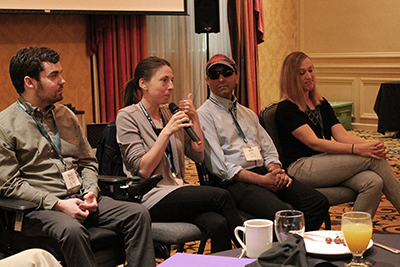
Panel of Computing Professionals with Disabilities
Panelists included Katie Sullivan, Microsoft; Sean Marihugh, Microsoft; Jessie Shulman, Expedia; and Joel Isaac, JP Morgan Chase.
How does your disability impact your education or career?
- My disabilities impacts the way I consume and output information. My learning disabilities make me process information differently than other people and I need more time to read email and other documents. I spend more time scheduling and making sure I have time to do these tasks.
- Through my transition from seeing to not seeing, I have learned that things in an electronic format are the best. I can lose information when people are speaking and pointing and referencing things in the room. I can’t lose information as easily if it’s electronic.
- I’ve had issues with communication being deaf. I often have to prepare more before meetings, whether it is arranging for captions or an interpreter. I try to share the captioning or video experiences I have with the others I’m having a meeting with so we’re on the same page.
- I have to make sure things are always physically accessible; advanced notice is key to make these changes. I have to request my office is set up a certain way, travel is planned in advance, etc.
When did you choose to disclose your disability to your job?
- I’m on an accessibility team. I figured I didn’t need to disclose until I met them, because I knew they’d be welcoming. When I was scheduled for my last job, I was hired through the Federal Government’s Schedule A hiring system, which is non competitive, so I had to disclose my disability.
- Because I need an American Sign Language (ASL) interpreter, I disclose before the interview so they know what to expect and what to do when we’re in the interview.
- It’s very situational and depends on your disability. When you have an invisible disability, it’s often a more complicated question. If I’m talking to a recruiter, I probably won’t disclose. If I’m talking to the direct hiring manager, I usually will, since they have to directly work with me and my disability. I often try to weave my disability into the job I’m applying for and share how it helps with my job preformance instead of hinders it.
- I usually disclose right when I’m hired so I can get the accommodations I need immediately, but it’s often on a case-by-case situation.
Have you had a negative issue with your disability and your employer?
- Since I have been progressively losing vision, I have had a hard time recognizing that I was changing or needing more accommodations. It took me six months to really admit to myself that my vision had changed. I had to start asking for help. I made it a negative experience for myself because I was worried about the stigma.
- I’m a terrible speller because of my disability, and I have a lot of anxiety about doing work in front of people and writing on the board. I’ve been embarrassed in front of other people before in the workplace.
- Deaf people may have a lot of accommodations, and this can be really hard for impromptu events. I always felt like I was missing out on those quick hall conversations—but I’ve quickly learned that people are willing to actively find me to talk about things.
- People with mobility issues often get extra scrutiny about whether they can actually travel on the job.
What do you wish employers knew to better retain employees with disabilities?
- Employers should create employee resource groups for people with disabilities and learning about assistive technology options.
- Employers should be open to talking about accommodations and the things that can be done to keep me engaged in the job.
- Employers need to be aware of the whole process. If the recruiter doesn’t know there are resources for people with disabilities, they won’t be as welcoming to people with disabilities.
- I was able to participate in a lot of internships in college that helped me test out my skills and the things I had learn and the tools I needed in the workplace. This really helped me know what jobs were right for me and what I needed once I got there.
- Schedule A and special inclusive hiring processes need to be well understood and employers need to know how to articulate these practices.
- Employers should break down workplace stigma about disabilities. Even before hiring a person with a disability, have differences in employee strengths and weaknesses and accommodations talked about in the workplace.
How do you feel about employers asking if you have a disability on applications? What is the ideal response to receive when you disclose?
- If employees are aware you’re looking for people with disabilities, they’re more willing to disclose and start that discussion—it’s all about how you explain how the information will be used.
- I am often turned off by that question because there’s always a huge disclaimer. It seems like a negative question, so I never want to answer.
- Do I make myself look like a weak candidate by disclosing my disability before even meeting a person? This is what I ask when I’m answering that.
- When I disclose, I want a supportive response, “Great, we have all these resources and this is how to get accommodations.” I want to be welcomed and hear about how I will be successful with that company. If I don’t get a response at all or a negative one, it worries me how it will be once I start the job.
- Managers should talk about all the resources they have to offer to all employee candidates, but also say you don’t have to take them.
How do you get involve more people with disabilities in the conversation and make the first encounter more welcoming?
- Most of my experiences have had me starting with an email for what I need from people for meetings, and people try to give me time to let me know when they’re planning on doing something.
- We tend to congregate with people who look and act like us, but once people start working with a person with a disability, they’re more welcoming. It’s better to be open and show people how to interact with you rather than hide it.
- A lot of my accommodations can also be very helpful to other people—taking digital notes and making action items, for example. People learn to appreciate these accommodations as a helpful collaborating tool.
- One of my managers had a disability as well, and she actually came in to talk to me and offered for us to host a workshop on my disability for my team, and I found that very welcoming and helpful to have someone there helping me navigate it.
How do you get people with disabilities applying for more jobs?
- When an employer hosts a specific career fair for people with disabilities with actual employees from the company, it creates a welcoming atmosphere and encourages more people to apply.
- Targeted outreach is very helpful—how do we take advantage of existing efforts to hire students with disabilities?
- Partnering with AccessComputing is a great way to connect students with disabilities with employers looking to hire people with disabilities.
How would you help combat bias in the workplace and build a better culture of acceptance at your workplace?
- Global Accessibility Awareness Day (GAAD) was created to help promote a better accessibility culture in the workplace and the public. We try to do something each year for GAAD where we can show others and teach our workplace and more about accessibility.
- People with disabilities hired into an organization can often be assumed to work in accessibility, or when a product is tested, they go to the people with disabilities first as the “model” of accessibility. Employers shouldn’t just assume people with disabilities are the know all/say all for disability culture or technology use..
- It’s okay to own your disability and use it as a strength. Creating a culture that accepts strengths and weaknesses is important.
- Disability resource groups should have hidden memberships so you don’t know who is in that group. This allows people to participate before disclosing.
- I used to think employee resource groups (ERGs) weren’t for me, but lately I’ve been more involved and learned that they really can make a difference and give a perspective on different aspects of my job. Working as a group makes my work more valuable because I have more input, and my work can be used by others. Sharing those resources gives more support for all of us.
- Resource groups have provided opportunities to me, like meeting with students and sharing my experiences, or meeting with others to share our issues and learn more from them together. Sharing the value of what is in a ERG and discussion group provides feedback for tools and accessibility of resources as well.
How do we make a business case for accessibility and those resources? How do you turn a positive response into funding, opportunities, and standards for our companies?
- Make sure managers are open to these resources and getting on board for employees participating. These mentalities often trickle down—if management gets on board, the employees will as well.
- Staffing, outreach for events, funding should all be considered—employees can only do so much because they need to do their main job. We need staff specifically signed on for these resource groups and more funding for these efforts.
- Continually push inclusivity as an important message for the company.
- The more people you get invested in accessibility, the more you won’t even have to bring it up—accessibility will be second nature to all people in a company.
Working Group Discussion Summaries
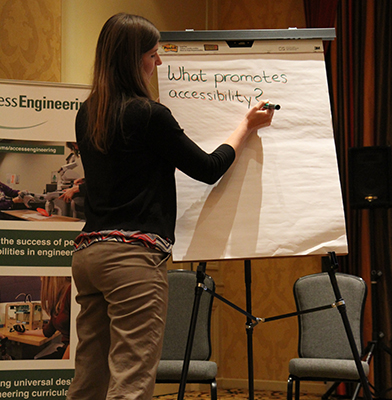
What can be done to make engineering labs, machine shops, and other activities accessible to students with disabilities?
By Katherine Steele and Maya Cakmak, University of Washington
This session included a presentation followed by a discussion.
What are the big things that we need to consider while making engineering labs, machine shops, and other activities as accessible as possible? We have been developing guidelines to help make hands-on learning more accessible in engineering labs and machine shops. This work draws from DO-IT’s publication Making Science Labs Accessible to Students with Disabilities and site visits to UW’s machine shop and engineering labs.
Using the Beam Robot, CBI participants took a virtual tour of the hardware lab in UW’s Computer Science and Engineering Department.
Elements of UD incorporated into the lab space included
- All cords run through the ceiling, and therefore aren’t a tripping hazard.
- All workstations have the same tools and feel, so no one feels isolated and everyone can be comfortable at any space.
- Buttons have tactile differences, so someone could use them by feel.
Elements that might present challenges for students with disabilities include
- Equipment that is on high workbenches that some individuals may be unable to reach
- Fluorescent lighting throughout the lab
- Workbenches that are not height adjustable
- Narrow aisles
- Analog dials on equipment may not be very accessible
- Uncertainty about how students with disabilities can contribute to group work
Strategies for increasing accessibility of engineering labs and machine shops include
- Different textures to label areas on items
- Plastic instead of glass
- Preferential seating
- Enlarged screens or microscopes
- Adjustable-height work surface
- Provide written and verbal instructions
- Modified procedures to use larger weights, computer numerical control (CNC), LabView, virtual instruments, or 3-D printing when a project as assigned is inaccessible
- Explicit strategies for ensuring that students with disabilities are playing an active role in group work, participating in hands-on work, leadership, or note taking
Some other resources that address accessibility issues in labs and machine shops include
- University of Pittsburgh’s Human Engineering Research Laboratory’s accessible machine shop and prototyping facility allows engineers with disabilities to use accessible equipment.
- Purdue University’s Accessible Biomedical Immersion Laboratory provides the opportunity to do biomedical research in an accessible and inclusive environment.
- Independence Science showcases fully accessible science classrooms and the integration of students with disabilities.
- Seattle Lighthouse for the Blind has been training people with visual impairments to become Boeing machinists.
What could be done at an institution to promote greater participation and success of students with disabilities in engineering?
CBI participants made the following suggestions:
- Increase accessibility awareness among faculty. Share best practices and case studies with them.
- Create a better support system for staff, faculty, and administration.
- Market engineering fields to students with disabilities, showcasing how engineering can benefit people with disabilities and the wide range of research that can be done in the field.
- Provide engineering-focused outreach events to middle and high school students with disabilities, including summer camps, workshops, and early entry classes.
- Partner with organizations on your campus or in your community that support individuals with disabilities.
- Teach courses on assistive technology to raise awareness about accessibility and universal design.
- Actively invite people with disabilities to meetings about diversity and other large impact conversations; include disability in diversity expectations.
- Focus on the individual strengths of each person.
- Start campus campaigns with staff, students, and faculty involved to raise awareness about accessibility.
- Provide universally designed lab equipment to all students.
- Include disability content in national conferences focused on celebrating and advocating for diversity.
- Create better, more accessible infrastructure so that buildings are welcoming to all students.
- Provide transcription services, and train faculty on how to use them.
- Leverage state resources to provide more funding for accessibility.
- Provide more mentors for students with disabilities from both within the university and outside of it.
- Include the perspective of individuals with disabilities in design and implementation.
- Engage with other universities and colleges to both keep up with new universal design ideas, as well as to spread awareness.
- Ensure that students with disabilities get more hands-on experience with research.
- Organize a student group to meet with the Dean of Student Affairs and other important stakeholders on campus.
- Add information about universal design, accessibility, and disability into the curriculum. Integrate it into core courses and offer more in depth stand alone courses.
- Educate professional and social networks about the strengths, and opportunities to support students with disabilities.
What are specific ways universal design and accessibility topics be integrated into the engineering curriculum?
CBI participants made the following suggestions:
- Have presentations by students with visible and invisible disabilities to put a face on diversity.
- Include universal design in introductory classes and capstone projects so that all students consider it at least once during their education.
- Make accessibility just another principle of engineering and include it as a part of the standards to get ABET certified.
- Have more faculty and educators invested in accessibility to spread awareness in their classes and on campus.
- Work ADA and universal design into engineering policy classes.
- Raise awareness about universal design by including students with disabilities in engineering courses; have panels featuring students with disabilities so that engineering students can put a face to universal design and accessibility.
- Discuss different learning styles and abilities in engineering classes.
- Have a class that goes out into the community and does a design review, seeing how design affects real world people, including people with disabilities.
- Integrate universal design into how you teach your class. Use a variety of teaching and testing techniques and include multiple means for accessing information. Have adjustable tables and lab infrastructure, as well as computer programs (e.g., LabVIEW) and equipment.
- Be willing to modify labs or equipment for a variety of disabilities.
- Use web resources to educate faculty on what other campuses are doing with accessibility and universal design. Seek knowledge from experts in the field of universal design (e.g., DO-IT) to make sure all information is up to date.
- Encourage every project to have universal design included as a key element.
- Build in funding for making labs and classes accessible.
- Use case studies to show students what kinds of projects they can incorporate into their education and careers. Have students do a research project based around how engineering design or technology affects people with disabilities.
- Have multiple representations in class of people with disabilities, such as images and graphics in class and around campus.
- Have mandatory accessibility training for all educators.
- Get user feedback from the engineering community, including students with disabilities.
- Include employers and the industry in the conversation.
- Include universal design in every engineering class, just as part of the process like any other engineering principle. All students should think about cost-effectiveness, practicality, user-design and accessibility.
How do the viewpoints of the individuals in the documentary Fixed affect how you would teach about topics related to disability and universal design in the engineering curriculum?
CBI participants made the following suggestions:
- I should show the film in class or include a link to the film in the syllabus so students get a background in disability and universal design related to engineering.
- We should include more philosophy and ethics discussions and lessons in engineering curriculum.
- After showing the film, I would host a panel of students with disabilities to discuss their own experiences.
- They should make an abridged version of the film as a stepping off point to discuss disability in engineering.
- Other films and lessons to include in engineering curriculum are Part of Me, Not All of Me or the Ted Talk on Hugh Herr called “The new bionics that let us run, climb and dance."
- We should promote the idea of technology as a means for greater universal design and promoting diversity. Technology and adaptation are about variety of the human experience, not just fixing a problem.
- I would screen this in some of my introductory classes and my capstone class, to show students that engineering is about diversity. I would also promote the idea of airing it during our campus diversity awareness week.
- If we promote the idea of design as a means of making anything possible, instead of “normalizing,” then we will create far more creative inventions.
How do we encourage others in our departments, institutions, professional organizations, and elsewhere to include information about disability, accessibility, and universal design in engineering courses?
CBI participants made the following suggestions:
- Add information, resources, and inclusive photos to our catalogs and websites.
- Require instructors to add universal design and accessibility information to their syllabi.
- Include universal design and accessibility to degree diversity requirements.
- Work with disability services offices to recruit students with disabilities and train faculty about accommodations.
- Promote more group work and projects instead of just lecture.
- Petition the Accreditation Board for Engineering and Technology, Inc (ABET) to add universal design to their criterion.
- Allow a variety of ways to measure student learning instead of just testing.
- Have more meetings around universal design and accessibility and celebrate all wins.
- Be proactive to making these changes instead of reactive.
CBI Participants
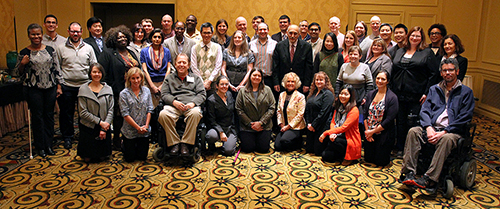
Stakeholder groups represented in the CBI included
- student service leaders and administrators,
- faculty members,
- students, and
- professional organizations.
The following individuals participated in the CBI.
Andersen, Christopher
Director, STEM Initiatives
Ohio State University
Atchison, Christopher
Assistant Professor
University of Cincinnati
Bennett, Cynthia
Ph.D. Student
University of Washington
Bhatti, Pamela
Associate Professor
Georgia Institute of Technology/Emory School of Medicine
Blaser, Brianna
Program Coordinator/Counselor
University of Washington
Burgstahler, Sheryl
Director, Accessible Technology Services
University of Washington
Cakmak, Maya
Assistant Professor, Computer Science and Engineering
University of Washington
Callahan, Bree
Director
University of Washington
Caspi, Anat
Director, Taskar Center for Accessible Technology
University of Washington
Chesney, David
Faculty
University of Michigan
Choi, Song
Assistant Dean
University of Hawaii at Manoa
Crawford, Lyla
Program Coordinator
University of Washington
Cree, Kevin
Student
Auburn University
Fahey, Katherine
Director, Student Disability Services
Cornell University
Garcia, Sergio
Graduate Research Assistant
Georgia Institute of Technology
Gepperth, Jason
Disability and STEM Resource Specialist
Wright State University
Gray, Kathryn
President, GrayTech Software, Inc.
University of Illinois, Urbana-Champaign engineering alumni
Hakansson, Nils
Assistant Professor
Wichita State University
Hefzy, Mohamed
Professor and Associate Dean of Graduate Studies of the College of Engineering
University of Toledo
Jenda, Overtoun
Associate Provost
Auburn University
Jones Calloway, Marcia
Director, Diversity & Inclusion
American Institute of Architects
Khan, Samee
Associate Professor
North Dakota State University
Ladner, Richard
Professor, Computer Science and Engineering
University of Washington
Lan, Mei-Fang
Clinical Assistant Professor
University of Florida
Lazar, Jonathan
Professor, Computer and Information Sciences
Towson University
Lee, Frank
Faculty
Bellevue College
Li, William
PhD Student / Graduate Instructor
MIT
Martin, Vincent
Graduate Research Assistant/ PhD student
Georgia Tech
McCombs, Michelle
Program Manager
Ohio State University
Mili, Fatma
Professor, Lead Purdue Polytechnic Institute
Purdue University
Moats, Steven
Director-Student Disability Resources
Iowa State University
Mortz, Margaret
Lecturer
Eastern Washington University
Park, Hae Won
Postdoctoral Fellow
Georgia Institute of Technology
Peixoto, Nathalia
Associate Professor
George Mason University
Sieglock, Joetta
Adaptive Technology Specialist
Eastern Washington University
Starling, Anna Leyf
Program Coordinator of The Engineering Place
North Carolina State University
Steele, Katherine
Assistant Professor, Mechanical Engineering
University of Washington
Stewart, Daniel
Graduate Research Assistant
University of Florida
Sundararajan, Sriram
Professor and Equity Advisor, College of Engineering
Iowa State University
Thompson, Constance
Senior Manager, Diversity & Inclusion
The American Society of Civil Engineers (ASCE)
Thompson, Terrill
Technoogy Accessibility Specialist
University of Washington
Tyson, Synge
Usability & Accessibility Consultant
Villalobos, Ric
Faculty Counselor
Spokane Community College
Wu, Chang-Yu
Professor and Department Head
University of Florida
Yasuhara, Ken
Research Scientist
University of Washington
Resources

Neuroscience for Neurodiverse Learners (NNL) compiles and creates resources for science, technology, engineering, and mathematics (STEM) educators working with neurodiverse students.
Community of Practice
NNL project staff and faculty leaders engage in an online Community of Practice (CoP) that includes key stakeholder groups that impact efforts to make neuroscience activities accessible for everyone (e.g., faculty, students, disability service units, informal science learning programs, teaching and learning centers, diversity programs, professional organizations). CoP participants share ideas and assist in the creation and dissemination of resources to encourage others to help a broader range of students and patrons learn about universal design and accessibility in neuroscience educational settings.
CoP members take part in the following:
- Identify and share ways to better serve neurodiverse students in classroom settings.
- Offer strategies for recruiting a wide variety of stakeholders to participate in project activities.
- Share disability-related and universal design content to be incorporated into classes.
- Learn about NNL events, training videos, resources, and publications.
- Identify unmet needs and useful products for the project to develop.
- Provide input for a project video and related online resources.
- Suggest future project activities.
Individuals can join the STEM Educators Community of Practice by contacting doit@uw.edu.
Knowledge Base
The NNL Knowledge Base currently contains over 650 Case Studies, Promising Practices, and Q&As regarding the accessibility of technology, college, graduate school, and careers for individuals with disabilities. Many articles focus on serving neurodiverse students effectively. Example articles include the following.
Promising Practices
- Across Campus and Beyond: A Promising Practice to Increase Conversations about Neurodiversity in the Engineering Classroom
- The Neurodiversity Initiative: A Promising Practice for Promoting Disability Awareness in Higher Education
Q&As
- Are there employment resources specifically designed to serve neurodivergent job seekers?
- What do “neurodiverse” and “neurodivergent” mean?
Case Studies
- Collaboration Struggles in an Engineering Lab: A Case Study About a Student with Autism
- Inaccessibility in a Calculus Course: A Case Study on Educating Faculty and Staff about Learning Disabilities
- Kim and Biology: A Case Study on Accommodations for Learning Disabilities
- Jan and Large Lectures: A Case Study on Accommodations for Psychiatric Disorders
Other Web Resources
Find informational briefs and videos on the NNL website.
- STEM and Neurodiversity: A Capacity Building Institute for Faculty at Community and Technical Colleges (2022)
Summaries and video presentations from the 2022 NNL CBI. - Equal Access: Universal Design of Neuroscience Education and Research
Learn how to create neuroscience facilities and resources accessible to people with disabilities. - Promising Practices That Engage People with Disabilities in the CNT
A series of strategies for including people with disabilities in other engineering research centers. - Checklist for Making Engineering Labs Accessible to Students with Disabilities
Designing engineering labs so that all students can fully participate. - Equal Access: Universal Design of Engineering Departments
Guidelines on creating an accessible engineering department using universal design. - Equal Access: Universal Design of Your Engineering Research Center (ERC)
A checklist for making ERCs welcoming, accessible, and usable. - Equal Access: Universal Design of Your Project
A checklist for making projects welcoming, accessible, and usable
Campus Resources
Many post-secondary campuses will house organizations and groups that are supportive of students with disabilities, including neurodiverse learners. Examples at the University of Washington campus include the following.
- Huskies for Neurodiversity: Huskies for Neurodiversity is a student-led initiative that promotes visibility and acceptance of neurodiversity at the UW campus and beyond through articles, lived experience interviews with neurodivergent people, interactive website, and panel events. Their goal is to destigmatize and educate about neurodiversity and disability accommodations on campus to students and faculty, as well as provide a platform for neurodivergent individuals to share their stories and experiences in their own voice.
- Associated Students of the University of Washington Student Disability Commission: The Commission was established to create communities for individuals with disabilities and their allies by providing programming, resources, and a safe accessible space.
- UW Disability and D/deaf Culture Center: The UW Disability and d/Deaf Culture Center fosters a climate of social justice and pride, centered on universal design, access, and diversity. It cultivates disability and d/Deaf pride by promoting social justice through an inclusive environment, sharing resources for self-advocacy, developing educational programming, engaging stakeholders with principles of universal design, and promoting a transforming socio-cultural understanding of disability.
- Mad Campus: Mad Campus is a peer group for students identifying with or experiencing madness, mental illness, and/or neurodiversity. Mad Campus meets throughout the school year on a semi-weekly basis.
- Disability Studies Program: Disability studies at the UW involves a multi-campus interdisciplinary group of faculty, staff, students, and community members, who share an interest in questions relating to society’s understanding of disability. The undergraduate disability studies minor and the individualized studies major in disability studies provide opportunities for students to develop a strong interdisciplinary foundation in the social, legal, and political framing of disability.
- Disabilities, Opportunities, Internetworking, and Technology (DO-IT): The DO-IT (Disabilities, Opportunities, Internetworking, and Technology) Center is dedicated to empowering people with disabilities through technology and education. It promotes awareness and accessibility—in both the classroom and the workplace—to maximize the potential of individuals with disabilities and make our communities more vibrant, diverse, and inclusive.
Acknowledgments
The April 2023 Neuroscience for Neurodiverse Learners Capacity Building Institute was funded by the National Science Foundation (grant #DRL-1948591). Any opinions, findings, and conclusions or recommendations expressed in this material are those of the CBI presenters, attendees, and authors and do not necessarily reflect the views of the National Science Foundation or the University of Washington.
DO-IT’s Neuroscience for Neurodiverse Learners
University of Washington
uw.edu/doit/programs/nnl
© 2023 University of Washington. Permission is granted to copy this publication for educational, noncommercial purposes, provided the source is acknowledged.