We aim to inform students on how to prepare for well-rounded computing educational programs and careers. Engage in our online community, network with professionals in computing fields, learn advocacy skills, discover resources, and be up to date on inclusion- and accessibility-related opportunities, internships, conferences, events, and more.

AccessComputing Team Application

Apply to join our online community that features mentorship, resources, events, and other benefits

AccessUR2PhD

Receive mentoring, training, and other guidance towards a PhD in computing

Employment Resources

Access employment organizations, resume databases, and more resources for job seekers

Informational Briefs

2016 Report of the AccessSTEM/AccessComputing/DO-IT Longitudinal Transition Study (ALTS)

Read the analysis of data that tracks the college and career pathways of students with disabilities who have participated in activities sponsored by AccessComputing and DO-IT projects.

30 Web Accessibility Tips

These web accessibility tips can be used by web designers, developers, or content authors to guide them in creating or deploying web-based resources that are fully accessible to all users.

Accessibility and Universal Design of Online Meetings

Due to increasing public interest, and the emergence of more robust online conferencing tools, online meetings are increasing in frequency.

Advising Neurodivergent PhD Students

Discover good practices in advising students who are neurodivergent, including how to work with assistive technologies and where to access various resources for further guidance

College Survival Skills

Tips for students with disabilities to increase college success

Effective Communication: Faculty and Students with Disabilities

Tips for fully engaging students with disabilities

Equal Access: Universal Design of Your Presentation

A checklist for making your presentation welcoming and accessible to everyone

Equal Access: Universal Design of Your Project

A checklist for making projects welcoming, accessible, and usable

Equal Access: Universal Design of Your Research

A checklist for making research welcoming, accessible, and usable

Improving Equity and Access for Graduate Students with Disabilities

By focusing on equitable access rather than just compliance with legal requirements, faculty and administrators can help bridge the gap in educational experiences between disabled and non-disabled students.

Introduction to Quorum

Quorum is a general purpose tool that we call an "evidence-based" programming language. It started as a language for blind or visually impaired students.

Invisible Disabilities and Postsecondary Education

Many students on postsecondary campuses have disabilities that are not easily noticed. This situation can lead to misunderstandings.

Making a Makerspace? Guidelines for Accessibility and Universal Design

Many engineering departments, libraries, and universities are launching new initiatives to create makerspaces, physical spaces where students, faculty, and the broader community can gather and share resources and knowledge, work on projects, network, and

Moving On: Transitioning to Graduate School

In an active e-mentoring community, individuals with disabilities and mentors shared their advice included in this publication about how individuals with disabilities can successfully transition to graduate school.

Online Learning Strategies for Students with Disabilities

Over the last few years, postsecondary institutions continue to move many of their courses online. In this publication, some participants in projects supported by the DO-IT center at the University of Washington share their experiences and recommendations

Preparing for College: An Online Tutorial

The transition from high school to college is a big step for everyone. Students with disabilities have even more things to consider than their nondisabled peers.

Programming Languages and Learning

This web page is designed to provide an overview of recent evidence on human factors evidence in programming language design. In some cases, our intent is to dispel myths. In others, it is to provide the result of research lines.

Self-Examination: How Inclusive Is Your Campus?

It takes an entire campus, from administration to architecture to academics, to create a welcoming and inclusive environment. Accessibility issues should be considered at all levels.

Succeeding in Graduate School

In an active e-mentoring community, individuals with disabilities and mentors shared advice about how individuals with disabilities can be successful in graduate coursework.

Tips for Delivering an Accessible Presentation

Since the speaker is not likely to know specific characteristics of participants, it makes sense to be proactive and design a presentation that will be accessible to anyone—or, at least almost everyone—without the need for accommodations.

Videos

Captions: Improving Access to Postsecondary Education

Professors, students, and IT administrators share the benefits of using captions for videos used in postsecondary education.

Communication Access Realtime Translation: CART Services for Deaf and Hard-of-Hearing People

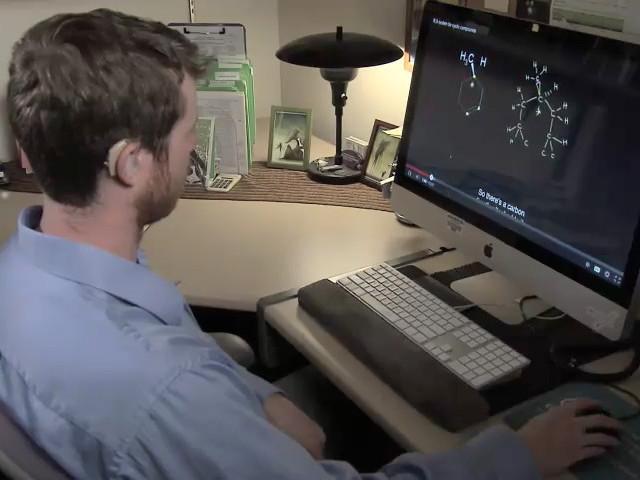
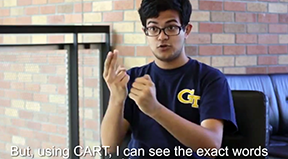
Communication Access Realtime Translation (CART) provides access to communication for individuals who are deaf.

Computer Access: In Our Own Words

In this video presentation, students with disabilities demonstrate the uses of adaptive technology and computer applications. It can be shown to teens with disabilities or to educators, parents, mentors, and other stakeholders.

Creating Accessible Documents

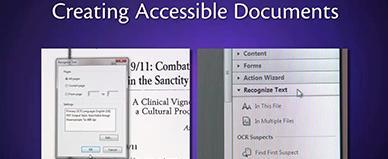
Regardless of whether documents are created in Adobe PDF, Microsoft Word, or another format, there are right and wrong ways to create documents in order to ensure people with disabilities can access them.

Graduate School and Students with Disabilities

Graduate students with disabilities, working with faculty and disability services, can have successful grad school experiences, complete their degrees, and enter rewarding careers.

How Can We Include Students with Disabilities in Computing Courses?

This video includes profiles of successful computing students and professionals who happen to have disabilities. Learn how accommodations, assistive technology, and universal design strategies can make computing courses accessible to students

IT Accessibility: What Web Developers Have to Say

University web designers and developers discuss the importance of creating websites that are accessible to all users.

Invisible Disabilities and Postsecondary Education

This video presentation shows effective accommodations for disabilities that include learning disabilities, attention deficits, autism spectrum disorders, and others that are not readily apparent.

It's Your Career

In this video presentation, college students with disabilities tell about work-based learning experiences and show how to gain access to these opportunities.

Making Videos Accessible

Learn what to consider when creating a video that it is accessible to all viewers, from pre-production techniques to the provision of captioning and audio description.

Mentoring Students with Disabilities in Research Experiences

Research experiences for undergraduates (REUs) are unique opportunities for students to learn about conducting research and exploring research career options.

Our Technology for Equal Access

This video highlights participants in DO-IT programs such as AccessComputing, who share information about the technology they use to access school, work, and the community.

Quality Education Is Accessible

Students with a variety of disabilities share strategies for making instruction more accessible to them.

Supporting Computer Science Student Mental Health

Long hours, lacking a sense of belonging, and fear of failure are just some stressors that affect computer science students and professionals alike, leading to burnout, anxiety, and depression.

Technology Advancements and Disability Identity

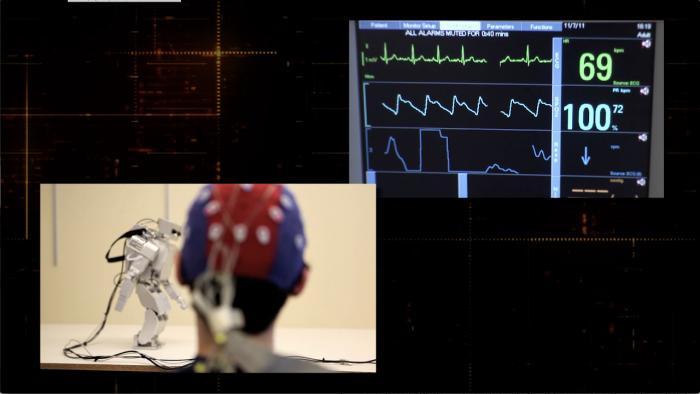
This video explores perspectives of individuals with disabilities as they discuss emerging technology that can enhance the human body and mind.

The Job Search and Disclosing your Disability

This video explores strategies for disclosing disability-related information in the workplace. Interns and employees with disabilities should consider if, when, and how they want to share information about their disability.

Using a Screen Reader

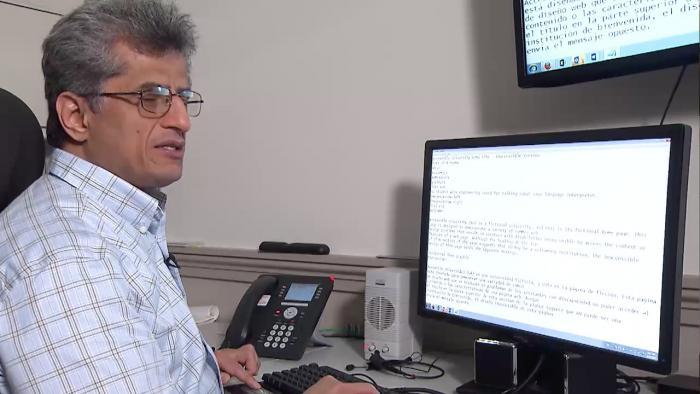
Expert Hadi Rangin demonstrates how web content sounds to someone using screen reader software and shares characteristics of accessible web pages.

What's It Like?

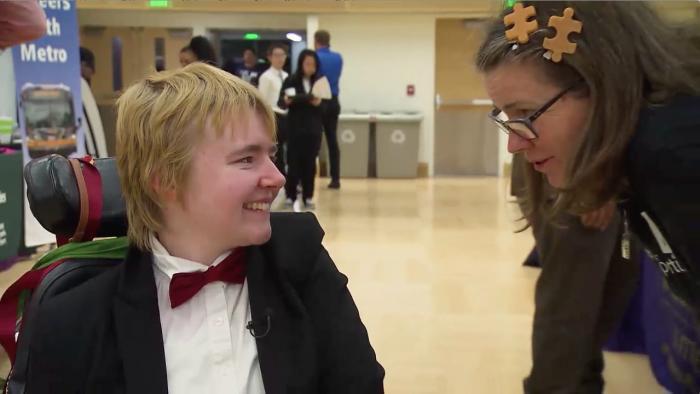
Learn about the experiences of college students with disabilities. Students discuss the perceptions of other people, how disability impacts their identity, and their approach to interacting with others.

Webinars

Book Chat with Rua Williams Slide Title

Book Chat with author Rua Williams: Disabling Intelligences: Legacies of Eugenics and How We are Wrong about AI

A live Q&A with Rua M Williams, author of Disabling Intelligences: Legacies of Eugenics and How We are Wrong about AI.
Where will I find the time slide deck title

Where Will I Find the Time? A Flexible Ecosystem Approach to Digital Accessibility Training

When it comes to digital accessibility training, instructors often ask, “Where will I find time to learn these new skills?” followed by, “Where do I start?”
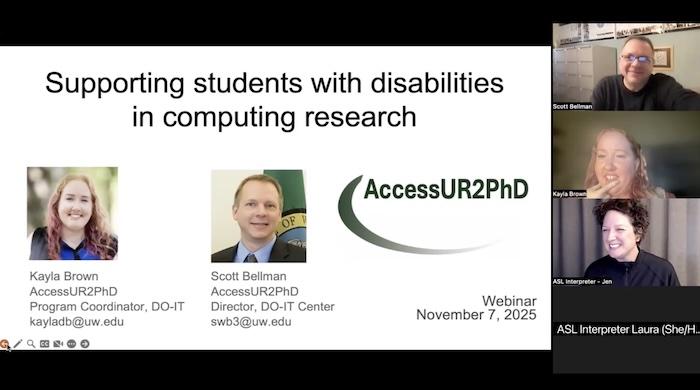
A screenshot from the webinar, with the AccessUR2PhD logo and showing Kayla Brown and Scott Bellman.

Supporting Students with Disabilities in Research

Learn practical strategies for creating more inclusive research opportunities, based on feedback from students with disabilities.
Impostor Phenomenon in an Academic Environment

Impostor Phenomenon in an Academic Environment

Impostor phenomenon, the feeling that you don’t truly belong, is common among academics and can negatively impact both quality of life and the pursuit of knowledge, regardless of actual achievements.
Screenshot from Zoom Webinar with two presenters and a QR code

GitHub's Pledge to Help Improve the Accessibility of Open Source Software at Scale

Learn how GitHub is working to make open-source assistive technology accessible and available to all, including people with disabilities.
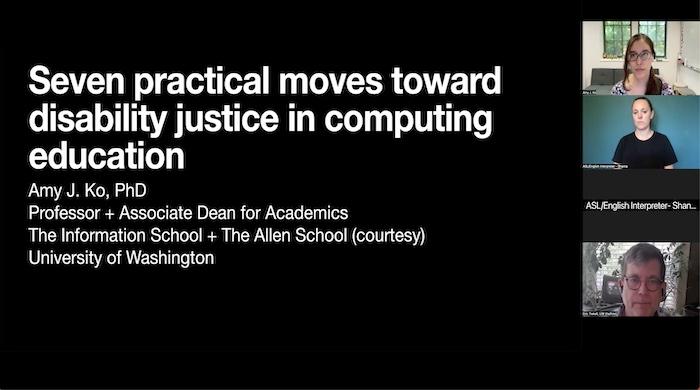
Screenshot of Zoom webinar

Seven Practical Moves Toward Disability Justice in Computing Education

Amy will share how she applies a Universal Design in Learning framework to her teaching through a disability justice lens that addresses intersections with race, gender, and class.
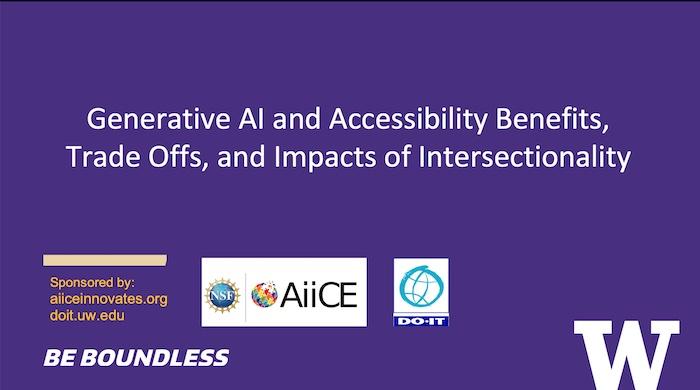
Webinar title slide

Generative AI and Accessibility Benefits, Trade-offs and Impacts of Intersectionality -

Researchers present findings on the the benefits, trades offs and impacts of using Generative AI for accessibility by members of the Deaf/HoH communities and Neurodivergent individuals.
Title slide from the Interdisciplinary Computing Instructors Workshop webinar recording

GAAD - Interdisciplinary Computing Instructor Workshop: Making Courses More Accessible

Learn about strategies for making computing courses more compliant with the new ADA 2026 digital accessibility requirements.
Title slide from the Strategic Interview Prep webinar recording

Strategic Interview Preparation

Learn how to strategically prepare for interviews
Title slide of Accessing STEM in Higher Education webinar recording

Accessibility for STEM in Higher Education

Panelists discussed their preferred methods for representing math equations, shared experiences with accommodations and emphasized self-advocacy, independence, and the value of community support.
Title slide from the Pathways to Greater Accessibility webinar recording

Pathways to Greater Accessibility and Inclusion for Postdocs with Disabilities

Dr. Mittendorf provides a historical overview of models of disability, specifically examining their impact on the treatment of disability within academia and related fields.
Title slide from the New ADA Title 2 webinar recording

The New ADA Title II Regulations on Digital Technologies: What it Means for Your School

Eve Hill explains the Department of Justice’s new ADA Title II regulation requiring websites and digital offerings of state & local governments as well as public institutions of higher education to comply with the Web Content Accessibility Guidelines 2.1
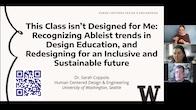
Title slide from This Class Isn't Designed for Me webinar recording

This Class Isn't Designed for Me!

Imagine a more inclusive and sustainable future of design education and hear case studies from personal experience in redesigning course experiences for students with disabilities.
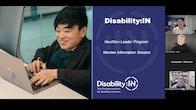
Title slide from the NextGen Leaders Initiative webinar recording.

NextGen Leaders Initiative

NextGen Leaders are college students and recent graduates with disabilities, including veterans, who represent sought after talent by Disability:IN’s 550+ Corporate Partner companies.
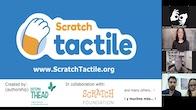
Title slide for Scratch Tactile webinar recording

Scratch Tactile: Making Creative Coding Accessible To All

Learn how Scratch Tactile's tangible programming blocks allow *all* students to learn together, creating an inclusive environment for everyone.
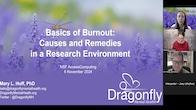
Title slide of the Basics of Burnout webinar recording

The Basics of Burnout

A facilitated discussion which defines the core components of burnout, presents evidence-based strategies to address the symptoms, and discusses how to prevent work-related stress.
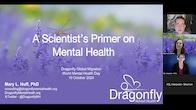
Title slide of Mental Health Literacy webinar recording

Introduction to Mental Health Literacy

Learn more about prevalence of mental health illness in general and in academic populations.
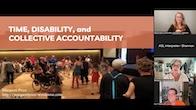
Title slide from Crip Spacetime webinar recording

Crip Spacetime: Access, Failure, and Accountability in Academic Life

Price argues for a turn toward collective accountability in order to make academe more accessible for all marginalized persons.
Title slide of the BIT Employment Services webinar with audio description recording

BIT - Employment Services for People in the Disability Community (Audio-Description)

The Blind Institute of Technology (BIT) provides employment services to individuals with any type of disability.
Title slide of BIT Employment Services webinar recording

BIT - Employment Services for People in the Disability Community

The Blind Institute of Technology (BIT) provides employment services to individuals with any type of disability.