
AccessComputing News - June 2026
AccessComputing News is distributed about twice a year and features event highlights, updates on our projects, and profiles of people making a difference in the world of accessibility and inclusion. Read this issue's articles below.
A Continued Era of Changes for AccessComputing
As we reported in the last issue of AccessComputing News, we made changes to the scope of our NSF-supported work to align with new NSF priorities in late 2025. We were recently informed by the NSF that we will not receive the 2027 increment for our Alliance Award. No decision has been made about increments beyond 2027.
Because our community is at the heart of what AccessComputing does, we are making budgetary changes to ensure that our staff is able to continue supporting our community and bringing together accessibility allies over the next few years. As a result, we will have limited funding available to support in-person convenings, mini-grants, and student travel until we are able to secure alternate funding.
If you want to support AccessComputing, you can donate to the AccessComputing Research & Support Fund. Stay tuned for further fundraising efforts coming later this year.
AccessComputing Student Team is Recruiting!
AccessComputing Workforce is recruiting students interested in learning about accessible technology and education. Our program provides mentoring, professional development, and more for students in computing-related fields.
The National Science Foundation Alliance AccessComputing Workforce works with students nationwide to engage them in accessibility. Designing technology with accessibility in mind benefits everyone. We can break down barriers with technology that’s accessible to people with disabilities, and employers are eager to hire professionals with these skills!
Benefits of joining the AccessComputing Workforce Team:
Accessibility Exploration
Learn about accessibility through webinars, resources, and discussions on topics such as accessible technology, inclusive design, assistive technology, and accessibility in education. Participants can explore how accessibility is shaping the future of computing and discover areas of interest for further study.Building Your Accessibility Network
Connect with peers, mentors, educators, researchers, and professionals who are passionate about accessibility. Through community discussions, networking opportunities, and introductions to leaders in the field, participants can build relationships and become part of a growing accessibility community.Professional Learning & Career Development
Students can build professional skills through workshops and individualized support from AccessComputing Workforce staff. We can provide feedback on resumes and cover letters, discuss career and graduate school pathways, help students identify research opportunities, and share information about conferences, workshops, and other opportunities to deepen their engagement with accessibility and computing.
Eligibility
- Participants must be 18+ and studying at a U.S. institution in a computing-related field (Associates, Bachelors, Masters, or PhD).
- International students on F-1 visas are welcome.
AccessComputing accepts applications year-round. Apply online now!
Gallaudet University Launches a New PhD Program
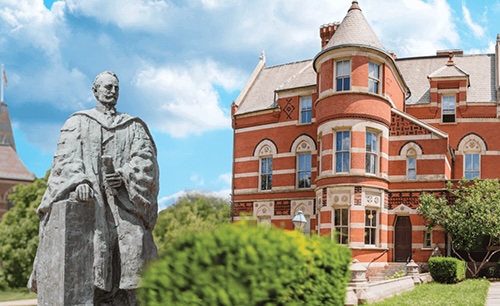
Gallaudet University's Ph.D. in Accessible Human-Centered Computing and Policy (AHCP) program welcomed its first cohort in Spring 2026. The program prepares scholars and practitioners to lead in the design, development, and evaluation of technologies, policies, and systems that advance accessibility and inclusion. Building on Gallaudet's mission as the world's premier bilingual ASL–English institution serving deaf and hard-of-hearing communities, AHCP fuses computing and design with public policy, recognizing that meaningful accessibility requires both technical innovation and the regulatory and standards infrastructure to sustain it.
Students complete at least 42 course credits and 15 dissertation research credits, for a total of 57 credits, over a four-to-six-year course of study, with coursework spanning accessible HCI, communication and information accessibility, accessibility standards (WCAG, Section 508, EN 301 549), interactive and data visualization design, and advanced research methods. Located in Washington, D.C., the program leverages proximity to federal agencies, industry partners, and advocacy organizations to support translational dissertation work aimed at real-world accessibility problems.
The core faculty—Raja Kushalnagar, Christian Vogler, and Abraham Glasser, all AccessComputing community members—bring deep ties to the broader accessible computing research community, and the AHCP Ph.D. is positioned as a natural pipeline for graduates who will shape the next generation of accessible computing research, policy, and standards leadership.
AccessComputing Mourns the Death of Richard Tapia

In late May, Richard Tapia, the namesake of the Tapia Celebration of Diversity in Computing, passed away at the age of 88. The conference was named after Richard Tapia, who was a mathematician, a faculty member at Rice University, and a fierce advocate for broadening participation in science, technology, engineering, and mathematics. Most years at the conference, CMD-IT (Center for Minorities and People with Disabilities in Information Technology) Founder Valerie Taylor would recall her conversation with Richard when he learned that the conference would be named after him. Richard asked Valerie, “Do you know something I don’t?” implying it would only be named after him if he were dying.
Over the last fifteen years, AccessComputing has sent numerous students to attend the Tapia Celebration to connect with mentors, peers, and professional development opportunities. In 2015, AccessComputing Founding PI, Richard Ladner was awarded Richard A. Tapia Achievement Award for Scientific Scholarship, Civic Science and Diversifying Computing at the Tapia Celebration. The award recognizes individuals who have made significant contributions to broadening participation in computer science.
Recent Awards to the AccessComputing Community

In the first part of 2026, we have been lucky to see many awards go to AccessComputing leadership, partners, and student team members. Congratulations to all our friends and colleagues!
- AccessComputing Founding PI Richard Ladner was awarded the Association for Computing Machinery’s Special Interest Group on Computer Science Education (SIGCSE) Award for Outstanding Contribution to Computer Science Education. The award honors the decades of work he has done to increase accessibility in CS education research and practice.
- AccessComputing co-PI Elaine Short (Tufts) was awarded the Computing Research Association’s Skip Ellis Early Career Award. The award recognizes “an early-career individual who demonstrates the potential for impactful contributions and leadership in their field of research, as well as has had a positive and significant impact on widening participation and improving access, opportunities, and positive experiences for all people in computing research and education.”
- Six AccessComputing Team Members were awarded National Science Foundation Graduate Research Fellowships including: Janet Jiang (UW), Ritesh Kanchi (Harvard), Gene Kim (MIT), Veronica Pimenova (University of Michigan), Ellie Seehorn (University of Michigan), and Tanisha Shende (Oberlin College). The NSF GRFP recognizes and supports outstanding graduate students in STEM fields.
- Former AccessComputing Team Member Ramin Ayanzadeh (UC Boulder) recently received a National Science Foundation (NSF) CAREER Award for his proposal on "Trustworthy Quantum Optimization."
- AccessComputing Partner Alisha Pradhan (New Jersey Institute of Technology) was a co-author with Ramprabu Thangaraj, Jed R Brubaker, Emma Dixon on Crafting Remembrance Beyond the Self: Older Adults’ Digital and Material Legacies, which received a best paper award at CHI 2026.
- AccessComputing PI Maya Cakmak's paper "Designing Accessible Robot Communication for Blind People" with Mina Huh, Amy Pavel, and others received the Best Paper award at the 3rd Workshop on Interactive AI for Human-Centered Robotics at CHI 2026.
- AccessComputing Partner Foad Hamidi and coauthors, Krystal Zhang, Marie Sakowicz, and Emily Wingeart, received an Honorable Mention Award at CHI 2026 for the paper "Belonging in the Making: Investigating Inclusive Makerspace Design for Youth with Autism."
- AccessComputing Partner Stephanie Ludi was an author of the paper named Most Influential Paper Award from the past 10 years "Eliciting programming challenges faced by developers with visual impairments: exploratory study,” at the 2026 Cooperative and Human Aspects of Software Engineering conference.
- AccessComputing partner Thijs Jan Roumen’s (Cornell) student Tobias Weinberg was awarded a prestigious Apple AI/ML fellowship.
- AccessComputing partner Nicki Washington (Duke) is the recipient of the 2025 ACM Frances E. Allen Award for Outstanding Mentoring. She is “recognized for exceptional commitment to diversifying the computing community at all education levels, demonstrating creativity and breadth in her approaches.”
- AccessComputing Partner Maitraye Das received an NSF CAREER award, for a project titled “AI-Augmented Creativity Support Tools in the Nonvisual Paradigm.”
- AccessComputing Partner Jeff Bigham (Carnegie Mellon, Apple) was named to the SIGCHI Academy for his contributions to the field of human-computer interaction.
New AccessComputing Resources

Across AccessComputing, we’ve continued developing resources of interest to our community. We hope you will check out some of them and share them with your colleagues who may be interested in learning more about accessibility in the classroom.
- Tips for Disabled Computing Students: Navigating Graduate School on the Path to a PhD
Read our new info brief in support of our continued work on engaging students with disabilities in research, funded by the Computing Research Association’s UR2PhD program. - Three new chapters are available in Teaching Accessible Computing
Edited by Alannah Oleson, Amy Ko, and Richard Ladner (University of Washington - UW).- Operating Systems + Accessibility, by Parthasarathy PD (BITS Pilani – Goa)
- Sustainable Computing + Accessibility, by Bedour Alshaigy (Uppsala University)
- Capstone and Thesis Projects + Accessibility, by Bedour Alshaigy (Uppsala University)
- New webinar recordings
- Impostor Phenomenon in an Academic Environment with Mary Huff (Dragonfly Mental Health)
- Supporting Students with Disabilities in Research with Kayla Brown and Scott Bellman (UW)
- Including Students with Disabilities in CS Education, Part 1 and Part 2 with Richard Ladner (UW)
- Where Will I Find the Time? A Flexible Ecosystem Approach to Digital Accessibility Training with Mary-Colleen Jenkins (UW)
- Book Chat with author Rua Williams: Disabling Intelligences: Legacies of Eugenics and How We are Wrong about AI with Rua Williams (Purdue)
- Disability, Pop Culture, and Technology with Kayla Brown (UW)
- Graduate Student Panel on pathways to a PhD in Computing with Jennifer Chien (University of California, San Diego), Stephanie Masotti (The University of Pittsburgh), Diego Guzman (University of California, Irvine), Tania Moharrery (Morgan State University), Olarinde Farayola (Towson University).
Disability and Accessibility at ACM CHI 2026
The ACM CHI Conference on Human Factors in Computing Systems (CHI 2026) was held in Barcelona, Spain, in April, 2026. CHI is the leading international conference on Human-Computer Interaction. There were more than 5,000 attendees and 1,705 papers with an acceptance rate of about 25%. Even though I was unable to attend the conference, I follow the contributions about disability and accessibility. There were nine sessions related to disability or accessibility, including 8 papers sessions (and a total of 55 papers) on these topics:
“Power, Values, and Politics of Accessibility”
“Accessibility in Everyday Life”
“Reading and Writing Accessibility”
“Practical and Adaptive Accessibility”
“Navigating Biases in Accessibility and Aging”
“Sound, Music, and Dance Accessibility”
“Designing for Sensory Access”
“Memory and Interaction.”
There were two workshops with the titles:
“Crip HCI: Cyborg Perspectives on Disability Justice”
“Speech AI for All: The What, How, and Who of Measurement”
There were three meet-ups with the titles:
“Disability, Differences, and Diversity: Revisiting Inclusive Design and Access”
“Neurodiversity Meet-Up @ CHI: Building a Neuro-Affirming Community in HCI”
“Sign-Up on Deaf Technologies: Reframing Access, Interaction, and Design”
There were approximately 323 papers, posters, and workshops that mentioned accessibility in their abstracts.
Partner representative Jeff Bigham was an author on a CHI 2026 Best Paper titled: “iTagPDF: Towards Finally Automating PDF Accessibility.” There were 62 Best Papers. Honorable mention papers, of which there were 213, included those authored by partner representatives Shiri Azenkot, Abraham Glasser, Foad Hamidi, Raja Kushalnagar, Kathryn Ringland, Rua Williams, and Jacob Wobbrock.
Now that I have explored the disability- and accessibility-related papers from CHI 2026, I picked a few to recommend. I will start with the Best Paper mentioned above. I have been frustrated about how hard it is to make a PDF accessible. Hopefully, this Best Paper will open a window to making it easier. I will then look for papers that relate to Gen AI, which has great promise to move the needle on accessibility. There are dangers in Gen AI that are real, but there is also promise for this powerful technology to improve access solutions.
Want another take on CHI? Check out Amy Ko's Bits and Behavior post "CHI 2026 trip report: ay ay AI."